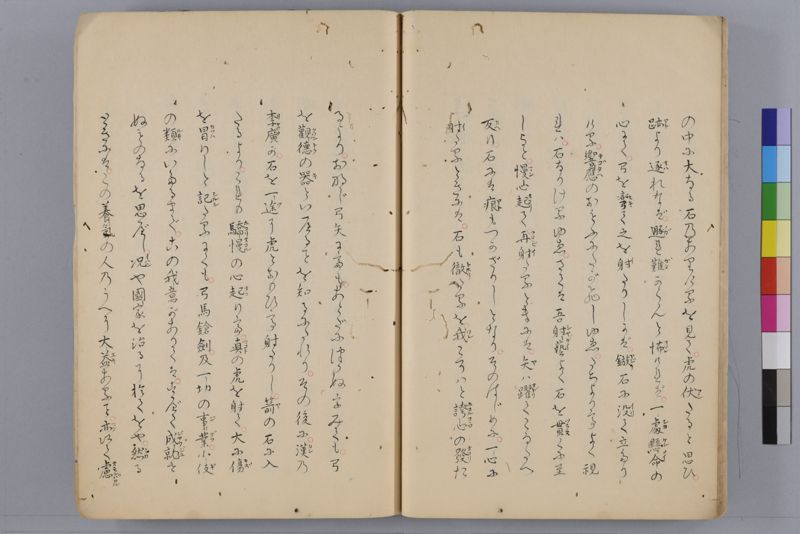
翻刻
【右丁】
の中に大なる石のありけるを見て。虎の伏(フシ)たると思ひ。
跡(アト)より逐(オハ)れなば。遯(ノガ)れ難(ガタ)からんと怖(オソレ)ければ。一⁻処(シヨ)懸(ケン)⁻命(メイ)の
心にて。弓を彎(ヒキ)て之を射(イ)たりしかば。鏃(ヤジリ)石に没(イリ)て立たり
ける。《振り仮名:響⁻応|テゴタヘ》のおもふにたがひしゆゑ。たちよりてよく視
れは。石なりけるゆゑ。さては吾 射(シヤ)⁻芸(ゲイ)よく石を貫(ツラヌ)くに至
しよと。慢(マン)⁻心 起(オコリ)て。再(フタヽビ)射(イ)たるときには。矢(ヤ)は躍(オドリ)てこなたへ
反(カヘ)り石には痕(アト)もつかざりしとなり。そのはじめに。一⁻心に
射(イ)たるときには。石も徹(トホリ)たるを。我(ワレ)こそはと誇(ホコル)-心(コヽロ)の発(オコリ)た
【左丁】
るより。おなじ弓矢にても。あとだにつかぬをみても。弓
を観(クワン)⁻徳(トク)の器(キ)といへることを知るにたれり。その後に。漢(カン)の
李広(リクワウ)が。石を一⁻途(ツ)に虎とおもひて射(イ)たりし。箭(ヤ)の石に入
たるより。これも驕(ホコリ)⁻慢(オコル)の心 起(オコ)りて。真(マコト)の虎を射て。大に傷(キズ)
を冒(カフム)りしと記(シルシ)たるにても。弓馬鎗剣。及一⁻切の事(ジ)⁻業(ゲフ)。小⁻伎(ギ)
の類(ルヰ)にいたるまで。この我⁻意がありては。すべて成(ジヤウ)⁻就(ジユ)せ
ぬものなるを思べし。況(イハン)や国⁻家を治るに於てをや。然(シカ)る
ときには。この養⁻気の人のうへに大-益(エキ)あること。亦(マタ)以て慮(オモンパカル)
現代語訳
【右丁】
草むらの中に大きな石があるのを見て、虎が伏せているのだと思い、後ろから追われたなら逃げ難いだろうと恐れたので、一所懸命の心で弓を引いてこれを射たところ、鏃が石に深く刺さって立っていた。手応えが思っていたのと違ったので、近寄ってよく見れば石であったので、「それでは我が射芸はよく石をも貫くほどに達したか」と慢心が起こって、再び射たときには、矢は跳ね返ってこちらへ戻り、石には跡もつかなかったという。最初に一心に射たときには石をも貫いたものを、「我こそは」と誇る心が起きた
【左丁】
ことから、同じ弓矢でありながら、跡さえもつかないのを見ても、弓を徳を観る器といったことの意味がよく分かる。その後、漢の李広が、石を一途に虎と思って射たところ、矢が石に入ったことで、これも驕り慢ずる心が起こり、真の虎を射て大いに傷を負ったと記されていることを見ても、弓・馬・槍・剣、および一切の事業、小さな技芸の類に至るまで、この我意があっては、すべて成就しないものであることを思うべきである。まして国家を治めることにおいてはなおさらである。そうであるならば、この養気が人の上に大いに益があることも、また十分に考えられるべきことである。
英語訳
【Right page】
He saw a large stone lying in the undergrowth and, mistaking it for a crouching tiger, feared that if it were to pursue him from behind, he would have no way to escape. With a desperate, single-minded resolve, he drew his bow and shot at it — and the arrowhead buried itself into the stone and stood there fast. Since the sensation upon impact differed from what he had expected, he approached and looked closely, only to find it was a stone. At this, the thought arose in him: "Then has my archery skill reached the point where I can even pierce stone?" — and with this conceit in his heart, he shot again. This time, the arrow bounced back toward him, and left not a single mark on the stone. In the first shot, when he had fired with a completely unified mind, the arrow had pierced even stone; but from the moment that the prideful thought of "I have done it!" arose within him —
【Left page】
— even with the very same bow and arrows, the arrow left not a trace. This alone is enough to understand what the ancients meant when they called archery a vessel for observing virtue. Furthermore, it is recorded that later, Han dynasty general Li Guang (李広), upon shooting at a stone he had single-mindedly taken to be a tiger, had his arrow enter the stone, whereupon the same prideful and conceited mind arose in him — and when he subsequently shot at a real tiger, he suffered grave injuries. From this account as well, one should reflect that in archery, horsemanship, spear, and swordsmanship — and indeed in all endeavors, down to the smallest of technical skills — nothing can be accomplished when this self-will (我意) is present. How much more so in the governing of a nation and state. This being so, the great benefit that this cultivation of vital energy (養気) brings to a person's life is likewise something well worth considering.