翻刻
【右丁】
べし。
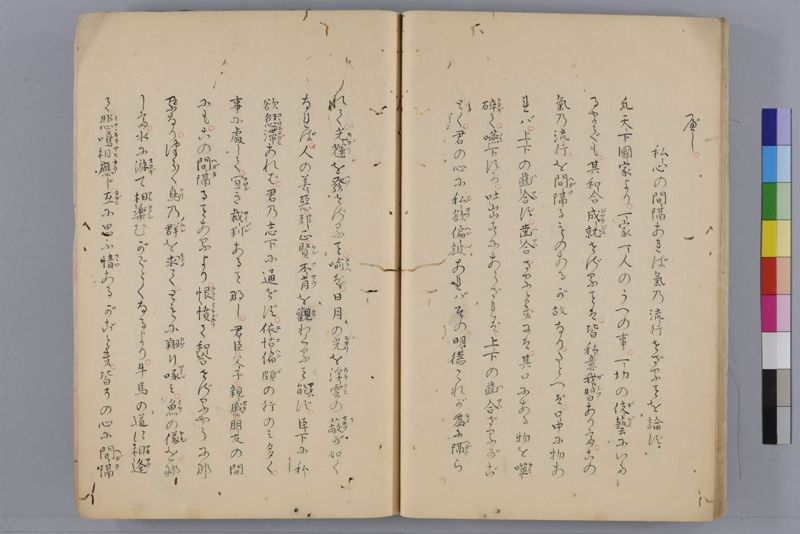
私⁻心の間⁻隔あれば気の流⁻行せざることを論ず。
凡天⁻下国⁻家より。一⁻家一⁻人のうへの事。一⁻切の伎(ギ)⁻芸(ゲイ)にいた
るまでも。其和⁻合 成(ジヤウ)⁻就(ジユ)せざることは。皆私⁻意 我(ガ)⁻習(シフ)ありて。この
気の流⁻行を《振り仮名:間⁻隔|ヘダツ》ることのあるが故なり。たとへば。口⁻中の物あ
れば。上⁻下の歯(ハ)-合(アハ)ず。歯(ハ)-合(アハ)ざるときには。其口にある物を噬(カミ)-
砕(クダキ)#1て。嚥(ノミ)-下すか。吐-出すにあらざれば。上⁻下の歯(ハ)合(アハ)ざるがご
とく。君の心に私(シ)⁻欲(ヨク)偏(ヘン)⁻詖(バ)【ママ】あれば。その明⁻徳これが為(タメ)に隔(ヘダテ)ら
【左丁】
れて。《振り仮名:光⁻輝|ヒカリ》を発(ハツ)せざること。喩(タトヘ)ば。日月の光(ヒカリ)を浮(ウキ)⁻雲(クモ)の蔽(オホフ)が如く
なれば。人の善⁻悪、邪⁻正、賢不(フ)⁻肖(セウ)を観(ミ)わくること能(アタハ)ず。臣⁻下に私⁻
欲 《振り仮名:愆⁻滞|コヽロエタガヒ》あれば。君の志下に通ぜず。依(エ)⁻怙(コ)⁻偏頗(ヘンバ)の行のみ多く。
事に処して。宜(ヨロシ)き裁(サイ)⁻判(バン)あることなし。君⁻臣、父⁻子、親⁻戚(セキ)、朋⁻友の間
にも。この《振り仮名:間⁻隔|ヘダタ》ることあるより。恨(ウラミ)⁻憤(イキドホリ)て和⁻合せざるやうにな
るなり。つら〳〵鳥(トリ)の群(ムレ)を求(モトメ)て。ともに翔(カケ)り啄(ツイバ)み。魚(イヲ)の隊(トモ)をな
して。水に游(オヨギ)て相(アヒ)-楽(タノシ)むがごとくなるより。牛馬の道に相(アヒ)-逢(アフ)
て。《振り仮名:悲⁻鳴|イナヽキテ》相(アヒ)-応(オウ)じ。互(タガヒ)に思ふ情(コヽロ)あるがごとき。皆その心に《振り仮名:間⁻隔|ヘダテ》
現代語訳
【右丁】
(前頁より続き)べきである。
私心の間隔があれば気が流行しないことを論ずる。
およそ天下・国家から、一家・一人の上のこと、一切の技芸に至るまでも、その和合が成就しないことは、みな私意・我習があって、この気の流行を隔てることがあるからである。たとえば、口の中に物があれば、上下の歯が合わない。歯が合わないときには、その口にある物を噛み砕いて飲み下すか、吐き出すかしなければ、上下の歯が合わないように、君主の心に私欲・偏頗があれば、その明徳がこのために隔てられ、
【左丁】
輝きを発することができないこと、たとえば日月の光を浮雲が覆い隠すようになれば、人の善悪・邪正・賢不肖を見分けることができない。臣下に私欲・心得違いがあれば、君主の志が下に通じず、依怙贔屓・偏頗な行いのみが多く、事に当たって適切な裁判(裁断)のあることがない。君臣・父子・親戚・朋友の間にも、この隔たりがあることから、恨み憤って和合しないようになるのである。つらつら思うに、鳥が群れを求めてともに飛び回り啄ばみ、魚が群れをなして水に泳いで互いに楽しむようなことから、牛馬が道で互いに出会って嘶いて呼び応じ、互いに思い合う情があるようなことまで、みなその心に隔たり
英語訳
【Right page】
(Continued from previous page) — worth careful consideration.
A Discussion on How the Obstruction Caused by Selfish Thoughts Prevents the Flow of Vital Energy
In all things — from the realm of the nation and state down to the affairs of a single household or a single person, and even to the level of all technical arts and skills — whenever harmony and fulfillment fail to be achieved, it is invariably because self-centered intentions (私意) and self-serving habits (我習) exist, causing an obstruction to the free flow of this vital energy (気). It is as if there is something lodged in the mouth: when something is between the teeth, the upper and lower teeth cannot come together. When the teeth cannot meet, unless that thing in the mouth is either bitten and crushed and swallowed, or spat out, the upper and lower teeth will never close. In the same way, if a ruler's heart harbors selfish desires and partiality, his luminous virtue (明徳) is obstructed by these and
【Left page】
— ceases to radiate its light. It is as though the light of the sun and moon is covered over by drifting clouds — in such a state, one becomes unable to discern a person's goodness or wickedness, crookedness or uprightness, worthiness or unworthiness. If the retainers and ministers harbor selfish desires and misguided notions, the ruler's intentions will not reach those below; there will be an abundance of favoritism and partiality, and when dealing with matters, there will be no sound judgment or fair decisions. Between ruler and minister, father and child, relatives, and friends as well — it is from the presence of this obstruction that resentment and indignation arise, and they fail to achieve harmony. When one reflects deeply upon this — just as birds seek out their flock to soar and peck together, or fish form schools and swim in the water delighting in each other's company, or as oxen and horses, upon meeting one another on the road, whinny and call to each other in response, each bearing a feeling of affection toward the other — in all of these, the hearts involved are free of obstruction,