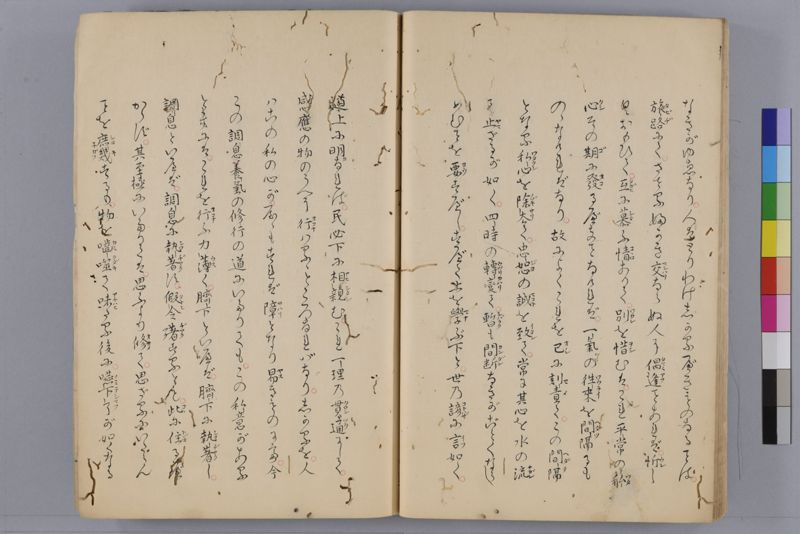
翻刻
【右丁】
なきがゆゑなり。人はとりわけしかるべきものなることは。
旅(タビ)⁻路(ヂ)にて。させるふかき交(マシハリ)ならぬ人に偶(タマ〳〵)-逢(アフ)ことあれば。忻(ウレ)し
くおもひて。互(タガヒ)に慕(シタ)ふ情(コヽロ)ありて。別(ワカレ)を惜(ヲシ)むは。これ平⁻常の私(ワタ)⁻
心(クシ)その期(ゴ)に発(オコ)るべきことなければ。一⁻気の往(ワウ)⁻来(ライ)を《振り仮名:間⁻隔|ヘダツ》るも
のゝなければなり。故によくこれを己(オノレ)に《振り仮名:刻⁻責|セメ》て。この《振り仮名:間⁻隔|ヘダテ》
となる《振り仮名:私⁻心|ワタクシ》を除(ノゾキ)⁻去(サリ)て。忠⁻恕(ジヨ)の誠(マコト)を致(イタシ)て。常に其心を水の流(ナガレ)
て止(ヤマ)ざるが如く。四⁻時の《振り仮名:転⁻変|ウツリカハリ》て。暫(シバラク)も間(カン)⁻断(ダン)なきがごとくならし
めむことを要(ヨウ)すべし。すべて上を学(マナ)ぶ下と。世の諺(コトハザ)に言(イフ)如く。
【左丁】
道⁻上に明 ̄カなれば。民必下に相(アヒ)-親(シタシ)む。これ一⁻理の貫(クワン)⁻通(ツウ)にして。
感応の物のうへに行(オコナ)はるゝところなればなり。しかるを。人
はこの私の心が、やゝもすれば障(サハリ)となり易(ヤス)きものにて。今
この調⁻息、養⁻気の修⁻行の道にいたりても。この私⁻意がある
ときには。これを行(オコナ)ふ力-薄(ウス)く。臍⁻下といへば。臍⁻下に執(シフ)⁻著(ヂヤク)し。
調⁻息といへば。調⁻息に執(シフ)⁻著(ヂヤク)す。《振り仮名:仮-令|タトヒ》《振り仮名:著|ヂヤク|ツク 》するとも。此(コヽ)に住(トヾマ)るべ
からず。其至⁻極にいたりては。思ふより修(オサメ)て。思ざるにいたらん
ことを《振り仮名:庶⁻幾|シヨキ|ネガフ 》するも。物を噛(カミ)-噬(クダキ)て味(アチハヒ)たる後に。《振り仮名:嚥⁻下⁻了|ノミテシマフ》が如くなる
現代語訳
【右丁】
(前頁より続き)ないからである。人はとりわけそうあるべきものであることは、旅路にて、さほど深い交わりのない人にたまたま出会うことがあれば、嬉しく思って、互いに慕う情があり、別れを惜しむのは、これは平常の私心がその時に生じるべき理由がないから、一気の往来を隔てるものがないからである。ゆえによくこれを自分自身に厳しく省みて、この隔てとなる私心を除き去り、忠恕の誠を尽くして、常にその心を水が流れて止まないように、四季が移り変わりて暫くも間断なきがごとくならしめることを心がけるべきである。すべて上を学ぶ下と、世の諺に言う如く、
【左丁】
道が上で明らかであれば、民は必ず下において互いに親しむ。これは一理が貫き通じて、感応の働きが物事の上に行われるところだからである。しかるに、人はこの私の心が、ともすれば障りとなりやすいものであって、今この調息・養気の修行の道に至っても、この私意があるときには、これを行う力が薄く、臍下といえば臍下に執着し、調息といえば調息に執着する。たとえ執着するとしても、そこに留まってはならない。その至極に至っては、意識して修めて、意識せずに至らんことを願うのも、物を噛み砕いて味わった後に飲み込んでしまうようなものである。
英語訳
【Right page】
(Continued from previous page) — free of obstruction. That this is especially and particularly how it should be for human beings is evident from the following: when traveling along the road, if one happens to encounter a person with whom one has no particularly deep acquaintance, one nevertheless feels a sense of joy, and there arises a mutual feeling of warmth and fondness, and one is reluctant to part ways. This is because in that moment there is no occasion for ordinary selfish thoughts to arise, and therefore there is nothing obstructing the free passage of the unified vital energy (一気). For this reason, one ought to rigorously examine and reproach oneself, remove and cast away this selfish thinking (私心) that becomes the very source of obstruction, bring forth the sincerity of loyalty and empathy (忠恕), and constantly ensure that one's heart flows like water without ceasing, and changes like the four seasons without the slightest interruption. Just as the world's proverb says: "Those below learn from those above" —
【Left page】
— when the Way is made clear above, the people below will inevitably draw close to one another. This is because a single principle (一理) pervades and flows through all things, and it is there that the workings of resonance and response (感応) are put into practice in the world. And yet, the selfish mind in a person is prone to easily becoming an obstacle. Even when one has come this far — to the practice of breath regulation (調息) and the cultivation of vital energy (養気) — if this self-centered intention (私意) is present, the power with which one carries out the practice becomes thin and weak. If told to focus on the area below the navel (臍下), one becomes fixated on the area below the navel; if told to regulate the breath (調息), one becomes fixated on regulating the breath. Even if one does become fixated, one must not remain stuck there. At the ultimate stage of this practice, even the aspiration to progress from conscious cultivation toward effortless naturalness is like chewing food, savoring its taste, and then simply swallowing it whole —