翻刻
【右丁】
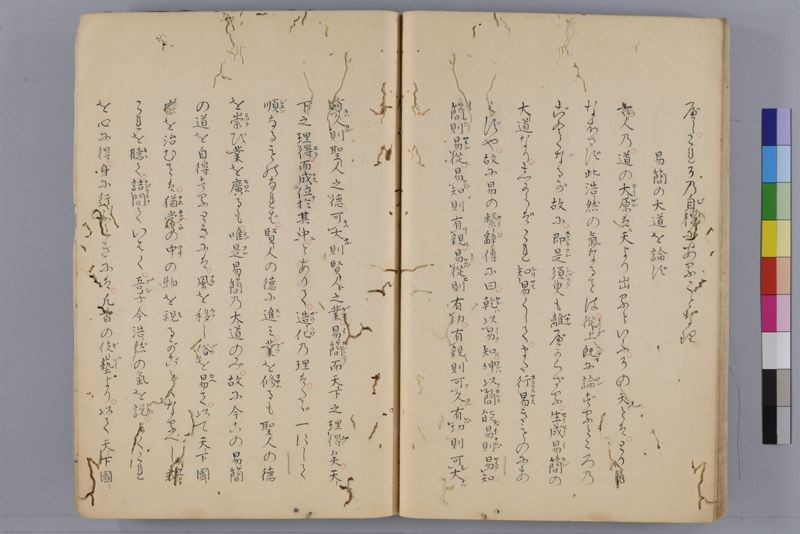
べし。これその《振り仮名:自⁻得|ジトク》にあることなり。
易簡の大道を論ず
古⁻人の。道の大(タイ)⁻原(ゲン)は天より出るといふ。その天とは。とりも
なほさず此浩⁻然の気なることは。《振り仮名:従⁻上|イマヽデ 》既(スデ)に論(ロン)ずるところの
ごとくなるが故に。即(スナハチ)是(コレ)《振り仮名:須⁻臾|シバラク 》も離(ハナル)べからざる。生(セイ)⁻成(セイ)易(イ)⁻簡(カン)の
大⁻道なり。しからばこれ知(シリ)-易(ヤス)くして。また行(オコナヒ)-易(ヤス)きものにあ
らずや。故に易の繫(ケイ)⁻辞(ジ)⁻伝に曰。乾(ケン) ̄ハ以_レ易(イ) ̄ヲ知 ̄リ。坤(コン) ̄ハ以 ̄テ_レ簡(カン) ̄ヲ能 ̄ス。易(イ)則(ナレバ)易(ヤスク)_レ知。
簡 ̄ナレハ則 易(ヤスシ)_レ従 ̄ヒ。易 ̄ケレバ_レ知則有 ̄リ_レ親 ̄ミ。易 ̄ケレバ_レ従 ̄ヒ則有_レ功。有_レ親 ̄ミ則可 ̄ク久 ̄カル。有 ̄レバ_レ功則可 ̄シ_レ大 ̄ナル
【左丁】
可 ̄キハ_レ久 ̄カル則聖⁻人之徳。可 ̄キハ_レ大 ̄ナル則賢⁻人之 業(ゲフ)。易(イ)⁻簡(カン) ̄ニシテ而。#1天⁻下之理-得(ウ)矣。天⁻
下之理-得(エ) ̄テ而 。#1成(ナス)_二位 ̄ヲ於其-中 ̄ニ_一、とありて。造(ザウ)⁻化(クワ)の理は。たゞ一にして
順(ジユン)なるものなれば。賢⁻人の徳に進(スヽ)み。業(ゲフ)を修(オサム)るも。聖⁻人の徳
を崇(タツト)び。業を広(ヒロム)るも。唯(タヾ)是(コレ)易⁻簡の大⁻道のみ。故に今この易⁻簡
の道を自⁻得するときには。風(フウ)を移(ウツ)し俗(ゾク)を易(カヘ)て。以て天⁻下国⁻
家を治むことは。猶(ナホ)掌(タナゴヽロ)の中(ウチ)の物を視(ミ)るがごとくなるべし。或(アルヒト)
これを聴(キヽ)て。《振り仮名:詰-問|ナジリトフ》ていはく。《振り仮名:吾⁻子|ゴシ》。今浩⁻然の気を説(トキ)。よくこれ
を心に得、身に行ふときには。凡⁻百の伎(ギ)⁻芸(ゲイ)より。以て天⁻下国⁻
現代語訳
【右丁】
(前頁より続き)べきである。これはその自得にあることである。
易簡の大道を論ず
古人が「道の大原は天より出る」と言う。その天とは、とりもなおさず、この浩然の気のことであることは、今まで既に論じてきたところのごとくであるから、すなわちこれは須臾も離れることのできない、生成・易簡の大道である。しからばこれは知り易くして、また行い易いものではないか。ゆえに『易』の繫辞伝に曰く、「乾は易をもって知り、坤は簡をもって能くす。易なれば則ち知り易く、簡なれば則ち従い易し。知り易ければ則ち親しみあり、従い易ければ則ち功あり。親しみあれば則ち久しかるべく、功あれば則ち大なるべし。
【左丁】
久しかるべきは則ち聖人の徳、大なるべきは則ち賢人の業。易簡にして天下の理を得る。天下の理を得て、その中に位を成す」とあって、造化の理はただ一にして順なるものであれば、賢人の徳に進み業を修めるも、聖人の徳を崇び業を広めるも、唯これ易簡の大道のみである。ゆえに今この易簡の道を自得するときには、風を移し俗を変えて、もって天下・国家を治めることは、なお掌の中の物を見るようなものであろう。ある人はこれを聞いて、詰り問うていわく、「ご高説。今、浩然の気を説き、よくこれを心に得て、身に行うときには、凡百の伎芸より、もって天下・国家を
英語訳
【Right page】
(Continued from previous page) — that is how it should be. This lies in one's own self-attainment (自得).
A Discussion of the Great Way of Ease and Simplicity (易簡の大道)
The ancients said that "the great origin of the Way proceeds from Heaven." That "Heaven," as has already been discussed up to this point, is none other than this vast, flowing vital energy (浩然の気). Therefore, it is a Great Way of generation and becoming (生成) — one of ease and simplicity (易簡) — from which one must not be separated for even a single moment. If that is the case, is it not something that is easy to understand and easy to practice? For this reason, the Appended Statements (*Xici zhuan*) of the *Book of Changes* (*Yi jing*) states: "Heaven (*qian* 乾) makes itself known through ease (*yi* 易); Earth (*kun* 坤) accomplishes itself through simplicity (*jian* 簡). What is easy is easily known; what is simple is easily followed. What is easily known generates affection; what is easily followed generates achievement. Through affection, one can endure; through achievement, one can become great.
【Left page】
That which can endure is the virtue of the sage; that which can become great is the work of the worthy person. Through ease and simplicity, the principles of all under Heaven are grasped. Once the principles of all under Heaven are grasped, one establishes one's position within their midst." Since the principle underlying the transformations of nature (造化) is simply one and harmonious, whether one advances in the virtue of the worthy person and cultivates their work, or whether one reveres the virtue of the sage and extends their work — it is all solely through this Great Way of ease and simplicity. Therefore, when one has truly internalized and self-attained (自得) this Way of ease and simplicity, transforming the prevailing customs and changing the ways of the people in order to govern the realm and the nation will be as easy as looking at an object held in the palm of one's hand. Upon hearing this, a certain person challenged and questioned: "You, sir — you say that when one truly grasps the concept of the vast vital energy (浩然の気) in one's heart and puts it into practice in one's body, then from all manner of arts and skills to the governance of the realm and the nation —"