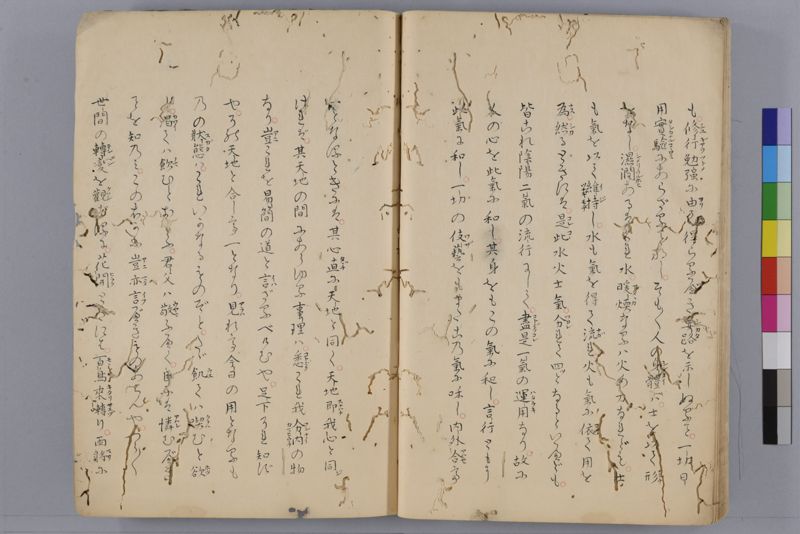
翻刻
【右丁】
も。《振り仮名:修⁻行|シユギヤウ》《振り仮名:勉⁻強|ツトメ 》に由(ヨリ)て得らるべき《振り仮名:要⁻路|シカタ》を示しぬること。一⁻切日⁻
用《振り仮名:実⁻験|タシカナルコヽロミ》にあらざることなし。そも〳〵人の身(シン)⁻体(タイ)は。土を以て形(カタチ)
をなし。《振り仮名:湿⁻潤|シメリウルホヒ》あるは□□れ水。《振り仮名:暖⁻煖|アタヽカ》なるは火の力なれども。□【土ヵ】
も気を以て《振り仮名:維-持|イジ|ツナギモチ 》し。水も気を得て流(ナガ)れ。火も気に依(ヨツ)て用を
為(ナス)。然(シカ)るときには。是(コレ)此(コノ)水火土気。分(ワカレ)れ#1て四ッとなるといへども。
皆これ陰⁻陽二⁻気の流⁻行にして。尽(コト〴〵ク)是(コレ)一⁻気の《振り仮名:運⁻用|ハタラキ》なり。故に
人の心を此気に和し。身をもこの気に和し。言⁻行ともに
此気に和し。一⁻切の《振り仮名:伎⁻芸|ワザ》をもまたこの気に和し。内⁻外-合(アハセ)て
【左丁】
一となるときには。其心 直(タヾチ)に天⁻地と同く。天⁻地 即(スナハチ)我-心と同 ̄ジ
ければ。其天⁻地の間にあらゆる事⁻理は。悉(コト〴〵ク)これ我《振り仮名:分⁻内|フンナイ|カマヒウチ》の物
なり。豈(アニ)これを易⁻簡の道と言(イハ)ざるべけむや。足⁻下それ知ず
や。その天⁻地と合して一となり。見(アラハ)れて今⁻日の用となるも
のの《振り仮名:状⁻態|スガタ》は。これいかなるものぞと。たゞ飢(ウエ)ては喫(クラハ)むと欲(ホツ)
□。渇(カワイ)ては飲(ノマ)むとおもふ。君⁻父は敬(ウヤマ)ふへく。臣⁻子は憐(アハレ)むべき
ことを知のみ。このほかに豈(アニ)亦(マタ)言(イフ)べきものあらんや。つら〳〵
世⁻間の転(テン)⁻変(ペン)を観(クワン)ずるに。花-開(ヒラク)ときには。《振り仮名:百-鳥|モヽ[トリ]》来(キタリ)-囀(サエヅ)り。雨 将(マサ)に
現代語訳
【右丁】
(前頁より続き)——その運用・効力の大なることも、修行・勉強(つとめ)によって得られるべき要路(しかた)を示し尽くしており、一切が日用の実験(たしかなるこころみ)に基づかないものはない。
そもそも人の身体は、土をもって形をなし、湿潤(しめりうるおい)あるは水、暖煖(あたたか)なるは火の力であるとはいえ、土も気をもって維持(つなぎもち)し、水も気を得て流れ、火も気によって用をなす。しからば、この水・火・土・気が分かれて四つとなるとはいえ、皆これ陰陽二気の流行にして、ことごとくこれ一気の運用(はたらき)なのである。ゆえに、人の心をこの気に和し、身もまたこの気に和し、言行ともにこの気に和し、一切の伎芸(わざ)もまたこの気に和し、内外合わせて
【左丁】
一となるときには、その心はただちに天地と同じく、天地すなわち我が心と同じくなれば、その天地の間にあらゆる事理は、ことごとくこれ我が分内(かまいうち)の物となる。あにこれを易簡の道と言わざるべけんや。足下、それ知らずや。
その天地と合して一となり、現れて今日の用となるものの状態(すがた)は、これいかなるものかと言えば——ただ飢えては食らわんと欲し、渇いては飲まんと思い、君父は敬うべく、臣子は憐れむべきことを知るのみ。このほかに、あにまた言うべきものがあろうや。
つらつら世間の転変を観ずるに、花の開くときには、百鳥(もも鳥)来たりて囀り、雨まさに
英語訳
【Right page】
(Continued from the previous page) — the greatness of its power of application and efficacy, and the means (*shikata*) by which it may be attained through practice and diligent effort, have all been fully set forth; there is not a single thing among them that is not grounded in the empirical testing (*jikken*) of everyday life.
Now then, the human body takes shape from earth, and that which has moisture and dampness is the power of water, and that which is warm is the power of fire — yet earth also sustains itself through vital energy (*ki*), water flows by receiving vital energy, and fire, too, fulfills its function by relying upon vital energy. This being the case, although water, fire, earth, and energy are said to be divided into four, they are all the circulation of the two energies of yin and yang, and are entirely the workings (*hataraki*) of a single vital energy. Therefore, when one harmonizes one's mind with this energy, harmonizes one's body with this energy, harmonizes one's words and deeds with this energy, harmonizes all arts and skills (*waza*) with this energy as well, and unites the inner and outer together as
【Left page】
one — then one's mind becomes directly one with Heaven and Earth, and Heaven and Earth become one with one's own mind; thus all the principles of affairs (*jiri*) that exist within Heaven and Earth become entirely things that fall within one's own domain (*fun'nai*). How could this not be called the Way of ease and simplicity? Are you not aware of this, sir?
As for what form the state of things takes when one has merged and become one with Heaven and Earth, manifested as the practical use of today — what manner of thing is it? It is simply this: when hungry, one desires to eat; when thirsty, one thinks to drink; one knows that one's lord and father are to be respected, and that one's retainers and children are to be cherished. Beyond this, what else could there possibly be to say?
When one surveys at length the changes and transformations (*tenpen*) of the world: when flowers open, the many birds come and sing; and when rain is about to —