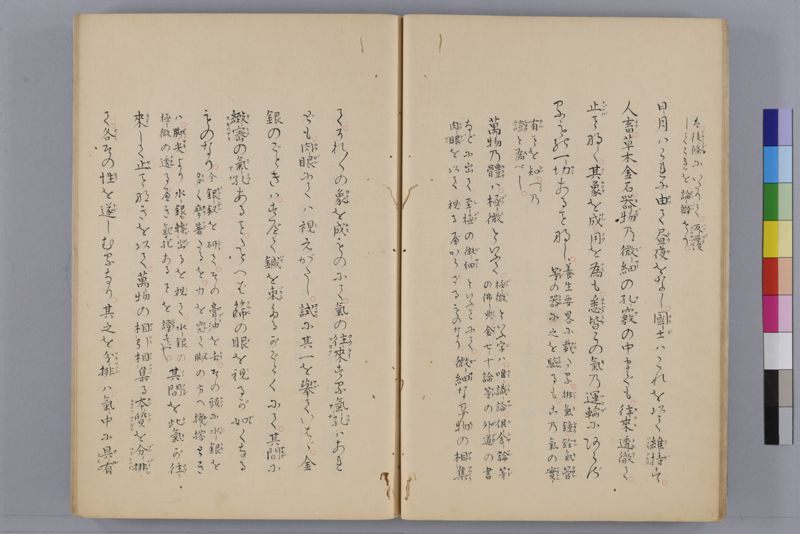
翻刻
【右丁】
《割書:は。《振り仮名:後-条|ノチノクダリ》にいたりて。《割書:《振り仮名:反-覆|ハンプク|クリカヘシ》》
してこれを《振り仮名:論-弁|ロンベン》せり。》
日-月はこれに由(ヨツ)て《振り仮名:昼-夜|チウヤ》をなし。《振り仮名:国-土|コクド》はこれを以て《振り仮名:維-持|イヂ|ツナギタモツ》す。
人畜( チク)。草木。金石。《振り仮名:器-物|キブツ》の《振り仮名:微-細|ビサイ》の《振り仮名:孔-竅|アナ》の中までも。《振り仮名:往-来|カヨヒ》《振り仮名:透-徹|トホリ》て。
止(トヾマル)ことなく。其象(ソノカタチ)を成(ナシ)、用(ヨウ)を為(ナス)も。悉(コト〴〵ク)皆(ミナ)この気(キ)の《振り仮名:運-輸|ハコブ》にあらざ
るもの《振り仮名:一-切| サイ》あることなし。《割書:養生要略に載(ノセ)たる、排気鐘(ハイキシヨウ)、銓気管(センキクワン)|等(ナド)の器(ウツハ)に之を験(コヽロム)事も。この気の《振り仮名:実-|マコトニ》》
《割書:有(アル)ことを知(シル)、一(ヒトツ)の|証(シヨウ)と為(ス)べし。》
万-物の体(カタチ)は。《振り仮名:極-微|ゴクミ》といふて。《割書:極(ゴク)-微(ミ)といふ字(ジ)は。唯(ユイ)-識(シキ)-論(ロン)。倶(ク)-舎(シヤ)-論(ロン)等(ナド)|の《振り仮名:仏-典| テン》。《振り仮名:金-七-十-論|コン 》 等(ナド)の《振り仮名:外-道|ゲダウ》の書》
《割書:などに出て《振り仮名:至-極|シゴク》の《振り仮名:微-細|ビサイ》といふことにて。|《振り仮名:肉-眼|ニクゲン| ガン》を以て視(ミ)るべからざるものなり》《振り仮名:微-細|ビサイ》なる物(モノ)の《振り仮名:相-集|アヒアツマリ》
【左丁】
て。それ〳〵の象(カタチ)を成(ナス)ものにて。気の《振り仮名:往-来|ワウライ|カヨフ》する《振り仮名:気-孔| コウ|アナ 》はあれ
ども。《振り仮名:肉-眼|ニクガン》にては視(ミ)えがたし。試(コヽロミ)に其一を挙(アゲ)ていはゞ。金
銀のごときは。すべて鍼(ハリ)を束(ツカネ)たるがごとくにて。其間( アヒダ)に
《振り仮名:緻-密|チミツ|スキマナキ》の《振り仮名:気-孔|キコウ|アナ 》あること。たとへば篩(フルヒ)の眼(メ)を視(ミ)るが如(ゴト)くなる
ものなり。《割書:今《振り仮名:銀-釵|ギンノカンザシ》を研(ミガキ)て。その《振り仮名:膏-油|アブラ》を去(トリ)。その頭(カシラ)に《振り仮名:水-銀|ミヅカネ》を|多(オホ)く《振り仮名:摩-著|スリツケ》たるを。力を究(イレ)て脚(アシ)の方へ《振り仮名:擯-搭|シゴク》とき》
《割書:は。《振り仮名:脚-尖|アシノサキ》より水-銀《振り仮名:転-出|コロゲイヅ》るを視(み)て。水-銀の|極-微の透(トホル)るべき《振り仮名:気-孔|アナ》あることを証(シヨウ)すべし。》其間(ソノアヒダ)を此気(コノキ)が《振り仮名:往-|ワウ》
来(ライ)して止(ヤム)ことなきを以て。万-物の《振り仮名:相-引|アヒヒキ》《振り仮名:相-集|アヒアツマ》る《振り仮名:本-質|ホンシツ|モチマヘノウマレツキ》 を 《振り仮名:分-排 ̄シ|ブンパイ |ワケヒロゲ》
て。各(オノ〳〵)その性(セイ)を遂(トゲ)しむるなり。其之を《振り仮名:分-排|ヒキワクル》は。気-中に《振り仮名:具-有|アル|コモル》
現代語訳
【右丁】
(この義については、後の条で繰り返し論弁している。)
日月はこれによって昼夜をなし、国土はこれをもって維持される。人畜、草木、金石、器物の微細な穴の中までも、往来し透徹して止むことなく、その形を成し、働きをなすのも、ことごとく皆この気の運搬によらないものは一切ない。(養生要略に載せてある排気鐘、銓気管などの器具でこれを験すことも、この気が実に存在することを知る一つの証拠とすべきである。)
万物の構造は、「極微」といって、(極微という字は、唯識論、倶舎論などの仏典、金七十論などの外道の書などに出て、至極の微細ということで、肉眼では見ることができないものである)微細なもの同士が集まって、
【左丁】
それぞれの形を成すものであって、気が往来する気孔はあるけれども、肉眼では見えにくい。試みにその一つを挙げて言えば、金銀のようなものは、すべて針を束ねたようなもので、その間に緻密な気孔があることは、たとえば篩の目を見るようなものである。(今、銀簪を磨いて、その油脂を去り、その頭に水銀を多く擦り付けたものを、力を入れて脚の方へ強く押すときは、脚先より水銀が転がり出るのを見て、水銀の極微が透る気孔があることを証明できる。)その間をこの気が往来して止むことがないことによって、万物の相互に引き合い集まる本質を分配して、各々その性質を遂げさせるのである。それを分配するのは、気の中に具わっている
英語訳
[Right page]
(This principle is repeatedly discussed and argued in later sections.)
The sun and moon create day and night through this [qi], and the land is maintained by means of this. Even within the microscopic pores of humans and animals, plants and trees, metals and stones, and vessels and implements, [qi] circulates and penetrates without cease. The formation of their shapes and the performance of their functions are entirely dependent on the transportation by this qi—there is nothing whatsoever that is not. (Testing this with instruments such as the air-displacement bell and qi-measuring tube described in the "Essentials of Health Cultivation" can serve as one proof of the real existence of this qi.)
The structure of all things consists of what is called "ultimate particles" (gokumi). (The term "ultimate particles" appears in Buddhist texts such as the Yogācāra-vijñānavāda-śāstra and Abhidharmakośa-śāstra, as well as in heterodox writings like the Sāṅkhyakārikā, meaning the utmost minuteness that cannot be seen with the physical eye.) These microscopic entities gather together
[Left page]
to form their respective shapes. Although there are pores through which qi circulates, they are difficult to see with the naked eye. To give one example: materials like gold and silver are essentially like bundles of needles, with minute pores between them, resembling the holes in a sieve. (If you polish a silver hairpin to remove its oils, apply mercury abundantly to its head, and press it forcefully toward the tip, you can observe mercury emerging from the pointed end, thus proving the existence of pores through which mercury's ultimate particles can pass.) Through the ceaseless circulation of this qi within these spaces, the fundamental nature that causes all things to attract and gather together is distributed, allowing each to fulfill its particular characteristics. This distribution occurs through what is inherent within the qi