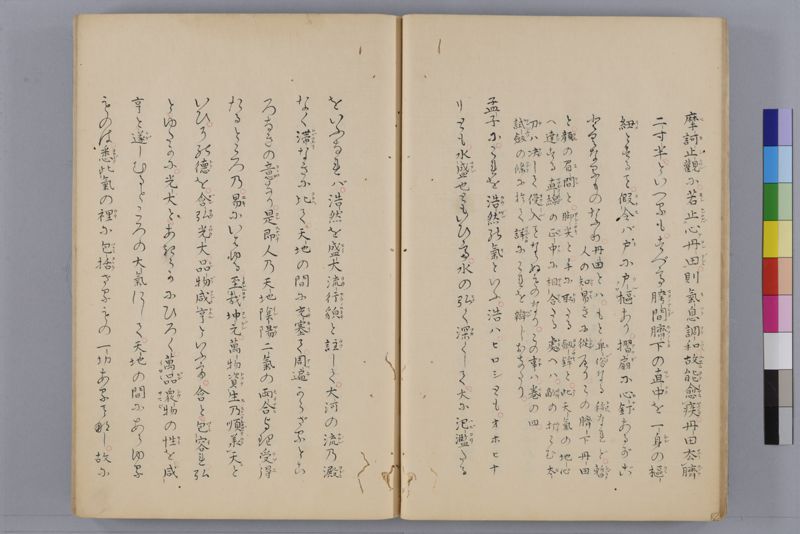
翻刻
【右丁】
《振り仮名:摩-訶-止-観|マカシクワン》に。若(モシ)止(トヾムレバ)_二心 ̄ヲ《振り仮名:丹-田|タンデンニ》_一。則 《振り仮名:気-息|キソク》《振り仮名:調-和|テウクワス》。故(ユヱニ)能(ヨク)癒(イヤス)_レ疾(ヤマヒヲ)。丹-田 去(サルコト)_レ臍(ホゾヲ)
二-寸-半、といへるも。すべて《振り仮名:胯-間|マタノアヒダ》《振り仮名:臍-下|ホゾノシタ》の《振り仮名:直-中|マンナカ》を《振り仮名:一-身| シン》の《振り仮名:枢-|クヽ 》
紐(リメ)とすること。《振り仮名:仮-令|タトヒ》ば戸(ト)に《振り仮名:戸-枢|クルヽ|クロヽ》あり。《振り仮名:摺-扇|アフギ》に《振り仮名:心-釘|カナメ》あるがご
とくなるものなり。《割書:丹-田とは。もと《振り仮名:卑-俗|ヒゾク》なる称(トナへ)なれど。暫(シバラク)|人の《振り仮名:知-易|シリヤス》きに従(シタガ)へり。この臍-下丹-田》
《割書:と。顔(カホ)の《振り仮名:眉-間|ミケン》と。《振り仮名:脚-尖|アシノサキ》と。手に取(トリ)たる《振り仮名:剣-鉾|タチノサキ》と。此(コノ)天-気の地-心|へ達(タツ)する《振り仮名:直線|マツズクノスヂ》の《振り仮名:正-中|マンナカ》に《振り仮名:相-合|アヒアヒ》たる処(トコロ)へは。敵(テキ)の打(ウチ)こむ《振り仮名:太-|タ》》
《割書:刀(チ)は決(ケツ)して《振り仮名:侵-入|オカシイル》ことならぬものなり。この事(コト)は。巻(マキ)の四。|《振り仮名:試-剣|ケンジユツ》の条(クダリ)に於て詳(ツマビラカ)にこれ弁(ベン)じおきたり。》
孟-子に。これを《振り仮名:浩-然|カウゼン》の気(キ)といふ。浩は。ヒロシとも。オホヒナ
リとも。《振り仮名:水-盛| サカン》也ともいひて。水の弘(ヒク)く深(フカ)くして、大に《振り仮名:氾-濫|ハビコリ》たる
【左丁】
をいふなれば。浩-然を《振り仮名:盛-大|セイ 》《振り仮名:流-行|リウカウノ》貌(カタチ)と註(チウ)して。大-河の流(ナガレ)の澱(ヨドミ)
なく滞(トヾコホリ)なきに比(タトへ)て。天-地の間に《振り仮名:充-塞|ミチキリ》て。《振り仮名:周-遍|アマネ》からざるとこ
ろなきの意(コヽロ)なり。是(コレ)即(スナハチ)人の天-地《振り仮名:陰-陽|インヤウ》二-気の《振り仮名:両⁻合|モチアイ》より《振り仮名:受-得|ウケエ》
たるところの。易(エキ)にいはゆる《振り仮名:至-哉|イタレルカナ》《振り仮名:坤-元|コンゲン》。万-物《振り仮名:資-生|トツテ 》 ̄ス乃(スナハチ)順(シタガツテ)承(ウク)_レ 天 ̄ニと
いひ。その徳(トク)を。《振り仮名:含-弘|ガンコウ》《振り仮名:光-大|クワウ 》。《振り仮名:品-物|ヒンブツ》《振り仮名:咸-亨|コト〴〵クトホル》といふて。含と、《振り仮名:包-容|ツヽミイ》れ。弘
と、ゆたかに。光-大と、あきらかにひろく。《振り仮名:万-品| ピン|イロ〳〵 》《振り仮名:衆-物|シウ |サマ〴〵 》の性(セイ)を、咸-
亨と、遂(トゲ)しむるところの大-気にして。天-地の間にあらゆる
ものは悉(コト〴〵ク)此-気の裡(ウチ)に《振り仮名:包-括|ツヽミクヽラ》ざるもの一-切あることなし。故に
現代語訳
【右丁】
『摩訶止観』に、「もし心を丹田に止めれば、則ち気息が調和する。故によく病を癒すことができる。丹田は臍から二寸半離れている」とあるのも、すべて股間臍下の真ん中を一身の枢要とすることである。例えば戸に蝶番があり、扇に要があるようなものである。(丹田とは、もとは卑俗な呼び名であるが、しばらく人の理解しやすさに従った。この臍下丹田と、顔の眉間と、足先と、手に取った剣の先端と、この天の気が地心へ達する直線の正中に合致した所へは、敵の打ち込む太刀は決して侵入することはできないものである。この事については、巻四の剣術の条において詳しく論じておいた。)
孟子は、これを浩然の気という。浩は、広いとも、大いなりとも、水が盛んとも言って、水が広く深くして、大いに氾濫している
【左丁】
ことを言うのであるから、浩然を盛大流行の様と注釈して、大河の流れに淀みなく滞りなきに例えて、天地の間に充ち満ちて、行き渡らないところがないという意味である。これは即ち人が天地陰陽二気の結合から受け得たところの、『易』にいわゆる「至れるかな坤元、万物資りて生ず、乃ち順って天に承く」と言い、その徳を、「含弘光大、品物ことごとく亨る」と言って、含とは包容し、弘とは豊かに、光大とは明らかに広く、万品衆物の性を、咸亨とは遂げしめるところの大気であって、天地の間にあるゆるものは悉くこの気の内に包括されないものは一切ない。故に
英語訳
[Right page]
In the "Mahā-śamatha-vipaśyanā" it states: "If one focuses the mind in the dantian, then the qi and breath become harmonized. Therefore, one can effectively heal illnesses. The dantian is located two and a half inches from the navel." This all refers to making the center between the thighs below the navel the pivot of the entire body. For example, it is like a door having hinges or a fan having a rivet. (Dantian is originally a vulgar term, but we temporarily follow what people can easily understand. At this dantian below the navel, at the space between the eyebrows on the face, at the tips of the feet, and at the tip of a sword held in hand - at these points that align with the center of the straight line where heavenly qi reaches the earth's core, an enemy's striking sword can never penetrate. This matter has been discussed in detail in the sword technique section of volume four.)
Mencius calls this the "qi of vast expansiveness" (hao-ran zhi qi). "Hao" means broad, or great, or abundant like water, referring to water that is wide and deep and greatly overflowing.
[Left page]
Therefore, "hao-ran" is annotated as the appearance of magnificent flowing, compared to a great river's flow without stagnation or obstruction, meaning it fills the space between heaven and earth with nothing left unpenetrated. This is precisely what humans receive from the combination of the yin-yang dual qi of heaven and earth, what the "Yi Jing" calls "Supreme indeed is the Kun principle! All things receive life from it, and it obediently receives from Heaven." Its virtue is described as "containing, magnanimous, luminous, and great; all things achieve fulfillment." "Containing" means embracing, "magnanimous" means abundant, "luminous and great" means clear and expansive, and "all achieve fulfillment" means this great qi enables all varieties and multitudes of things to realize their nature. Everything between heaven and earth is entirely encompassed within this qi without exception. Therefore,