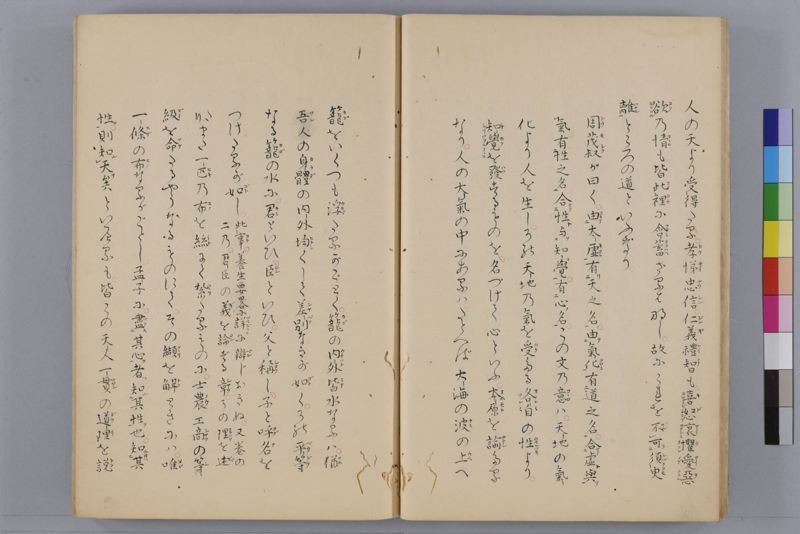
翻刻
【右丁】
人の天より受-得たる。孝(カウ)悌(テイ)忠(チウ)信(シン)。仁(ジン)義(ギ)礼(レイ)智(チ)も。喜(キ|ヨロコビ) 怒(ド|イカリ) 哀(アイ|カナシミ) 懼(ク|オソレ)
愛(アイ|メデ) 悪(ヲ|ニクム)
欲(ヨク|モトムル)の情(コヽロ)も皆《振り仮名:此-裡|コノウチ》に《振り仮名:含-蓄|フクミタクハへ》)ざるはなし。故にこれを不(ザル)_レ可 ̄ラ_二《振り仮名:須-臾|シバラクモ》
離(ハナル)_一ところの道といふなり。
周茂叔(シウモシク)が曰く。由(ヨリテ)_二《振り仮名:太-虚| キヨニ》_一。有 ̄リ_二 天之名_一。由 ̄テ_二《振り仮名:気-化| クワニ》_一。有_二道之名_一。合 ̄セテ_二虚 ̄ト与 ̄ヲ_一
《返り点:レ》気。有_二性之名_一合 ̄セテ_三性 ̄ト与 ̄ヲ_二知覚_一。有_二心 ̄ノ名_一。この文の意(コヽロ)は。天-地の気-
化より人を生し。その天-地の気を受(ウケ)たる《振り仮名:各-自|オノレ〳〵|ソレ〳〵 》の性(ウマレツキ)より。
《振り仮名:知-覚|チカク|シリワクルコヽロ》を発(ハツ)するものを、名づけて心といふ。《振り仮名:本-原|オホモト》を諭(サトシ)たる
なり。人の大-気の中にあるはたとへば大-海の波(ナミ)の上(ウへ)へ
【左丁】
籠(カゴ)をいくつも浮(ウカべ)たるがごとく。籠(カゴ)の《振り仮名:内-外|ウチソト》皆(ミナ)水なるは。猶(ナホ)
吾(ワレ)人の《振り仮名:身-体|カラダ》の内外 均(ヒトシ)くして《振り仮名:差-別|シヤベツ》なきが如(ゴト)く。その《振り仮名:平-等|ベウドウ》
なる籠(カゴ)の水に。君(キミ)といひ、臣(シン)といひ。父と称(シヨウ)し、子と呼(ヨブ)名(ナ)を
つけたるが如(ゴト)し。《割書:《振り仮名:此-事| コト》。養生要略に詳(ツマビラカ)に弁(べン)じおきぬ。又巻の|二の。君-臣の義(ギ)を論(ロン)ずる章(シヤウ)。その理(コトハリ)を述(ノべ)》
《割書:た|り。》また《振り仮名:一-匹| ヒキ》の布(ヌノ)を糸(イト)にて紮(クヽリ)たるものに。士 農(ノウ)工 商(シヤウ)の等(シ)-
級(ダイ)を命(ツケ)たるやうなるものにて。その纈(クヽリ)を解(トク)ときには。唯(タヾ)
《振り仮名:一-条| スジ》の布(ヌノ)なるがごとし。孟-子に。尽(ツクス)_二其心 ̄ヲ_一者 ̄ハ。知 ̄ル_二其性 ̄ヲ_一也。知 ̄ルトキハ_二其
性 ̄ヲ_一。則知 ̄ル_レ 天 ̄ヲ矣といへるも。皆この天-人《振り仮名:一-貫| クワン》の《振り仮名:道-理|ドウリ》を説(トク)
現代語訳
【右丁】
人が天から受け得た、孝悌忠信、仁義礼智も、喜怒哀懼愛悪欲の感情も、すべてこの気の内に含み蓄えられないものはない。故にこれを「須臾も離れることができない」ところの道というのである。
周茂叔が言うには、「太虚によって天の名がある。気化によって道の名がある。虚と気を合わせて性の名がある。性と知覚を合わせて心の名がある」。この文の意味は、天地の気化から人を生じさせ、その天地の気を受けた各自の性(生まれつき)から、知覚を発するものを名付けて心というのである。根本を説いたものである。人が大気の中にあるのは、例えば大海の波の上に
【左丁】
籠をいくつも浮かべたようなものである。籠の内外がすべて水であるのは、なお我々人の身体の内外が等しくして差別がないのと同じである。その平等である籠の水に、君といい、臣といい、父と称し、子と呼ぶ名をつけたようなものである。(この事は『養生要略』に詳しく論じておいた。また巻二の君臣の義を論ずる章でその理を述べた。)また一匹の布を糸で括ったものに、士農工商の等級を命じたようなもので、その括りを解くときには、ただ一条の布であるのと同じである。孟子に「其の心を尽くす者は、其の性を知る。其の性を知るときは、則ち天を知る」とあるのも、皆この天人一貫の道理を説いた
英語訳
[Right page]
What humans receive from Heaven - filial piety, fraternal respect, loyalty, trustworthiness, benevolence, righteousness, propriety, and wisdom, as well as the emotions of joy, anger, sorrow, fear, love, hatred, and desire - all are contained and stored within this qi without exception. Therefore, this is called the Way from which one "cannot depart even for a moment."
Zhou Maoshu said: "Through the Great Void, there is the name of Heaven. Through qi transformation, there is the name of the Way. Combining the Void and qi, there is the name of nature. Combining nature and perception, there is the name of mind." The meaning of this passage is that humans are born from the qi transformation of Heaven and Earth, and what develops perception from each individual's nature (innate character) that has received this qi of Heaven and Earth is called the mind. This explains the fundamental principle. Humans existing within the great qi is like floating several baskets on the waves of a great ocean.
[Left page]
The water being both inside and outside the baskets is just like how our human bodies have no difference between inside and outside, being equal. It is as if we gave names to that equal water in the baskets, calling them ruler and minister, father and son. (This matter was discussed in detail in "Essentials of Nurturing Life." Also, in the chapter discussing the righteousness of ruler and minister in volume two, this principle was explained.) It is also like taking a piece of cloth tied with thread and assigning it the class distinctions of scholar, farmer, artisan, and merchant - when those ties are untied, it becomes just one strip of cloth. When Mencius said, "Those who fully develop their minds know their nature. When they know their nature, they know Heaven," he was also explaining this principle of the unity between Heaven and humanity.