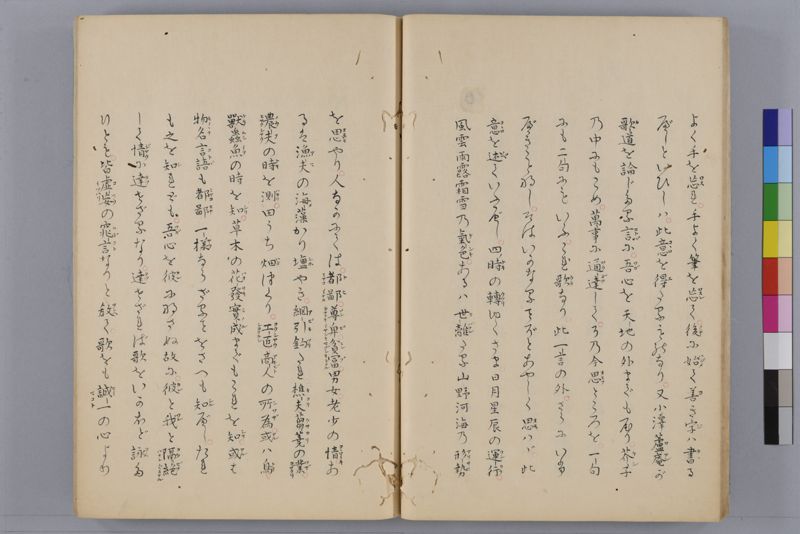
翻刻
よく手を忘(ワス)れ。手よく筆を忘(ワスレ)て。後(ノチ)に始(ハジメ)て善(ヨ)き字(ジ)は書(カヽ)る
べしといひしは。此/意(コヽロ)を得(エ)たるものなり。又小-沢-《振り仮名:蘆-庵|ロアン》が
歌(カ)-道を論じたる言(コトバ)に。吾(ワガ)心を天-地の外までもやり。《振り仮名:芥-子|ケシ》
の中にもこめ。万事に《振り仮名:通-達|ツウダツ》して。その今/思(オモフ)ところを。一-句
にも二-句にもいふ。これ歌(ウタ)なり。此一-言の外。さらにいふ
べきことなし。そはいかなることぞとあやしく思(オモ)はゞ。此
意(コヽロ)を述(ノべ)ていふべし。四 ̄ノ時(トキ)の転(ウツリ)ゆくさま。日月星辰の《振り仮名:運-行|ウンカウ》。
風雲雨露霜雪の《振り仮名:気-色|ケシキ》。あるは《振り仮名:世-離|ヨバナレ》たる山野河海の《振り仮名:形-勢|アリサマ》
を思(オモヒ)やり。人なかにては。《振り仮名:都鄙|トヒ|ミヤコイナカ》。 《振り仮名:尊卑|ソンピ|タフトキイヤシキ》。 《振り仮名:貧富|ヒンプ|マヅシキトメル》。 男女。老少の情(コヽロイキ)。あ
るは《振り仮名:漁-夫|アマ》の《振り仮名:海-藻|メ》かり塩(シホ)やき。《振り仮名:網-引|アビキ》釣(ツリ)たれ。《振り仮名:樵-夫|キコリ》、《振り仮名:蒭-蕘|クサカリ》の《振り仮名:業|ワザ|ヨワタリ》。
《振り仮名:農-夫|ノウフ|ヒヤクシヤウ》の時(トキ)を測(ハカリ)。田うち畑(ハタ)つくり。《振り仮名:工-匠|コウシヤウ|シヨクニン》、《振り仮名:商-人|アキビト》の所為(シワザ)。或(アル)は鳥(トリ)、
獣(ケモノ)、虫(ムシ)、魚(イヲ)の時を知(シリ)。草木の《振り仮名:花₋発|ハナサキ》《振り仮名:実₋成|ミノル》》までもこれを知(シリ)。或(アル)は
物名(モノヽナ)《振り仮名:言₋語|コトバ》も都(ミヤコ)鄙(ヒナ)一⁻様(ヤウ)ならざることをさへも知(シル)べし。たれ
も之を知(シ)れども。吾(ワガ)心を彼(カレ)になさぬ故に。彼(カレ)と我(ワレ)と《振り仮名:隔⁻絶|カクゼツ|ハナレ〴〵ニナル》
して情(ジヤウ)に達(タツ)せざるなり。達(タツ)せざれば歌をいかほど詠(ヨミ)た
りとも。皆《振り仮名:虚⁻妄|コマウ|イツハリ》の《振り仮名:窕⁻言|ムダゴト》なりと、教(ヲシヘ)て。歌をも《振り仮名:誠⁻一|セイ
|マコト》の心より
現代語訳
よく手を忘れ、手よく筆を忘れて、後に始めて良い字は書けるであろうと言ったのは、この意味を得たものである。また小沢蘆庵が歌道を論じた言葉に、「我が心を天地の外までも遣り、芥子の中にも込め、万事に通達して、その今思うところを一句にも二句にも言う。これが歌である。この一言の外、さらに言うべきことはない。それはどのようなことかと不思議に思うならば、この意味を述べて言うべきである。四季の移りゆく様、日月星辰の運行、風雲雨露霜雪の気色、あるいは世離れた山野河海の形勢
を思いやり、人中では、都鄙、尊卑、貧富、男女、老少の情、あるいは漁夫の海藻刈りや塩焼き、網引き釣り垂れ、樵夫や草刈りの業、農夫の時を測り、田打ち畑作り、工匠、商人の所為、或いは鳥、獣、虫、魚の時を知り、草木の花咲き実成るまでもこれを知り、或いは物の名や言葉も都鄙一様でないことさえも知るべきである。誰もこれを知っているけれども、我が心を彼になさない故に、彼と我とが隔絶して情に達しないのである。達しなければ歌をいかほど詠んだりとも、皆虚妄の窕言なり」と教えて、歌をも誠一の心より
英語訳
"Only when one forgets the hand, and the hand forgets the brush, can one begin to write good characters" - this saying captures this meaning. Also, in Ozawa Roan's discourse on the way of poetry, he said: "Send your heart beyond heaven and earth, contain it even within a mustard seed, penetrate all things, and express what you think now in one or two verses. This is poetry. Beyond this one statement, there is nothing more to say. If you wonder what this means and find it strange, I shall explain this intention. The changing aspects of the four seasons, the movements of sun, moon, and stars, the moods of wind, clouds, rain, dew, frost, and snow, or the forms of worldly mountains, fields, rivers, and seas
- contemplate these, and among people, the capital and countryside, high and low ranks, rich and poor, men and women, old and young and their emotions, or the fisherman's seaweed gathering and salt making, net pulling and line fishing, the woodcutter's and grass cutter's work, the farmer's measuring of seasons, rice field preparation and farming, the deeds of craftsmen and merchants, or knowing the seasons of birds, beasts, insects, and fish, knowing even the blooming and fruiting of plants and trees, or even knowing that the names of things and language are not uniform between capital and countryside. Everyone knows these things, but because they do not make their heart one with them, they and I remain separate and do not reach true emotion. If one does not reach it, no matter how many poems one composes, they are all empty delusions and meaningless words." Thus he taught that poetry too should come from a sincere and unified heart