翻刻
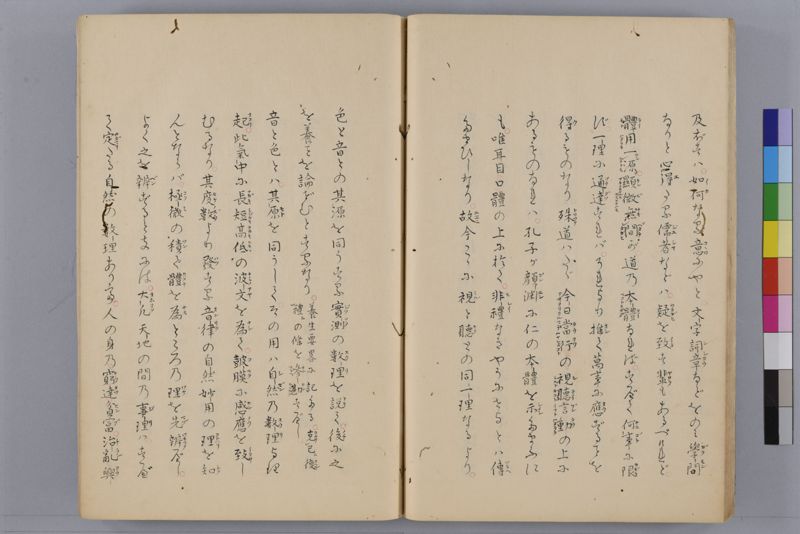
及ぼすは。如何(イカ)なる意(コヽロ)にやと。文-字《振り仮名:詞-章|シシヨウ》などをのみ《振り仮名:学-問|ガクモン》
なりと心-得(エ)たる《振り仮名:儒-者|ジユシヤ》などは。疑(ウタガヒ)を致(イタ)す輩(ヤカラ)もあるべけれど。
《振り仮名:体|テイ|モト 》-《振り仮名:用||ハタラキ》 一 ̄ニシ_レ《振り仮名:源||ミナモト》 ̄ヲ。《振り仮名:顕微|ケンビ|アキラカナルモ カスカナルモ》 《振り仮名:無|ナキ》_レ《振り仮名:間|ヘダテ|タガヒ》#1が。道の《振り仮名:本-体| タイ|マコトスガタ》なれば。すべて《振り仮名:何-事|ナニゴト》に限(カギラ)
ず。一-理に通達(ツウダツ)すれば。それより推(オシ)て万-事に応(オウ)ずることを
得(ウ)るものなり。殊(トリワケ)道はたゞ《振り仮名:今-日||アサヨリヨルマデ》 《振り仮名:当行|タウコウ|ハナレヌコト》の、《振り仮名:視 聴 言 動|シ テイ ゲン タウ|ミルトキクトイフトハタラク》の上に
あるものなれは。孔子が《振り仮名:顔-淵|ガンエン》に仁の本-体を示(シメシ)たまふに
も。唯耳、目、口、体の上に於て。《振り仮名:非-礼|ヒレイ》なきやうにせよとは伝(ツタヘ)
たまひしなり。故(ユヱニ)今こヽに視(ミル)と聴(キク)との同-一-理なるより。
色と音との其-源を同うする《振り仮名:実-測|ジツソク》の《振り仮名:数-理|スウリ》を説(トキ)て。後(ノチ)ニ之
を養ことを論ぜむとするなり。《割書:養生要略に記たる。克(カチテ)_レ己 ̄ニ復(カヘル)|_レ礼 ̄ニの条を《振り仮名:参-勘|サンカン|マジヘカンガフ》すべし。》
音と色とは。其-原(モト)を同うして。その用は《振り仮名:自-然|シゼン》の《振り仮名:数-理|スウリ》より
/起(オコリ)。此気-中に/長短高低(ナガキミジカキタカキヒキヽ)の/波(ナミ) ̄ノ-/文(アヤ)を/為(ナシ)て。《振り仮名:鼓-膜|コマク》に《振り仮名:感-応|カンノウ》を/致(イタサ)し
むるなり。其/度(タケ) ̄ノ/数(スウ)より/発(ハツ)する《振り仮名:音-律|オンリツ 》の自然妙-用の/理(コトハリ)を/知(シラ)
んとならば。《振り仮名:極-微|コクミ 》の/積(ツン)で/体(カタチ)を/為(ナス)ところの/理(ワケ)を/先(マヅ)《振り仮名:弁|ワキマフ》べし。
よく之を/弁(ベン)ずるときには。《振り仮名:大-凡|オホヨソ》天-地の間の《振り仮名:事-理|ジリ》は。すべ
て/定(サダマリ)たる自然の数-理ありて。人の身の、《振り仮名:窮-達|キウタツ》、《振り仮名:貧-富|ヒンプ》。《振り仮名:治-乱|チラン》、/興(コウ)-
現代語訳
及ぼすのは、どのような意図によるのかと、文字や詞章だけを学問だと心得ている儒者などは、疑問を抱く者もいるであろうけれど、体と用が一つの源を同じくし、顕微に間隔がないのが道の本体であるから、すべて何事に限らず、一理に通達すれば、それより推して万事に応ずることができるものである。とりわけ道はただ今日一日の当行である、視聴言動の上にあるものであるから、孔子が顔淵に仁の本体を示されるにも、ただ耳、目、口、体の上において、非礼でないようにせよとお伝えになったのである。故に今ここに視ることと聴くことの同一理であることから、
色と音がその源を同じくする実測の数理を説いて、後にこれを養うことを論じようとするのである。《養生要略に記した「己に克ちて礼に復る」の条を参照して考えるべし。》
音と色とは、その原を同じくして、その用は自然の数理より起こり、この気中に長短高低の波の文様を為して、鼓膜に感応を生じさせるのである。その度数より発する音律の自然妙用の理を知ろうとするならば、極微の積みで体を為すところの理をまず弁えるべきである。よくこれを弁ずるときには、大凡天地の間の事理は、すべて定まった自然の数理があって、人の身の窮達、貧富、治乱、興
英語訳
What is the intention behind extending this to such matters? Confucian scholars who understand only literary characters and compositions as true learning may have their doubts, but since substance and function share the same source, and there is no gap between the manifest and the subtle - this being the fundamental nature of the Way - in all matters without exception, once one penetrates a single principle, one can extend from it to respond to ten thousand affairs. Particularly since the Way exists solely in the daily practice of seeing, hearing, speaking, and acting, when Confucius revealed the fundamental nature of benevolence to Yan Yuan, he simply taught that in the use of ears, eyes, mouth, and body, one should avoid impropriety. Therefore, from the principle that seeing and hearing are of the same nature,
I will explain the mathematical principles of actual measurement showing how color and sound share the same source, and later discuss how to cultivate this. {{Reference should be made to the section on "overcoming the self and returning to propriety" recorded in the Essential Summary of Nurturing Life.}}
Sound and color share the same origin, and their function arises from the mathematical principles of nature, creating wave patterns of varying length, brevity, height, and depth in this atmospheric medium, thereby producing sympathetic response in the eardrum. To understand the principle of the natural mysterious function of musical temperament arising from these numerical degrees, one must first comprehend the principle by which the accumulation of atoms forms substance. When one can properly understand this, generally all phenomena and principles between heaven and earth have fixed natural mathematical laws, and human conditions of success and failure, poverty and wealth, order and disorder, rise and