翻刻
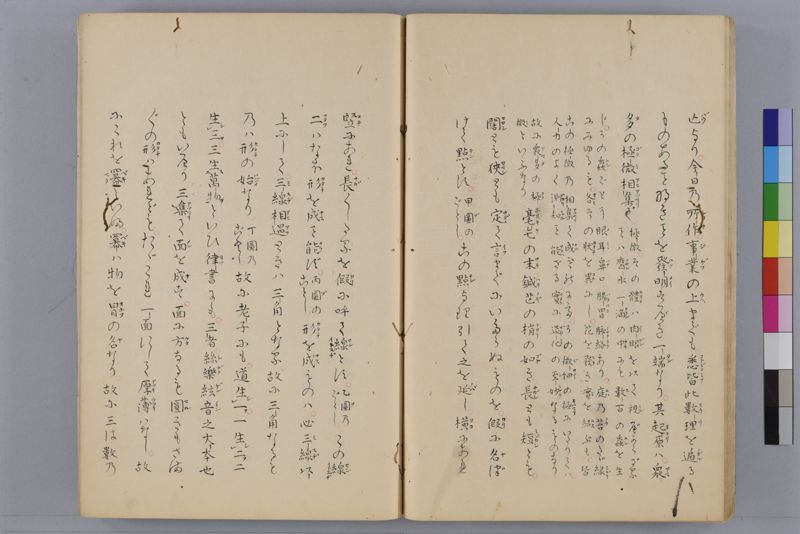
亡(バウ)より。今-日の《振り仮名:所-作|シヨサ》。《振り仮名:事-業|ジゲフ》の上(ウヘ)までも。悉(コト〴〵ク)《振り仮名:皆|ミナ》此《振り仮名:数-理|スウリ》を遁(ノガル)る
ものあることなきことを《振り仮名:発-明|ハツメイ》すべき一-端(タン)なり。其《振り仮名:起-原|オコリ》は。衆(アマ)-
多(タ)の《振り仮名:極-微|ゴクミ》《振り仮名:相-集|アヒアツマリ》て。《割書:極-微。その体(カタチ)は《振り仮名:肉-眼|ニクガン》を以て視(ミル)べからざる|ことは。腐(クサレ)-水 一-滴(タラシ)の中(ウチ)にも数(ス)-百の虫(ムシ)を生》
《割書:じ。その虫(ムシ)ごとに、眼(メ)耳(ミヽ)鼻(ハナ)口、《振り仮名:腸-胃|ハラワタ》《振り仮名:脈-絡|ミヤクラク》あり。庭(ニハ)の苔(コケ)のたゞ緑(ミドリ)|にみゆるも。各(オノ〳〵)その状(カタチ)を異(コト)にし。花を発(ヒラ)き実(ミ)を結(ムス)ぶも。皆》
《割書:この極-微の相-/集(アツマリ)て成(ナル)ものにて。その《振り仮名:微-細|ビサイ》の極(キハマリ)にいたりては。|人-力のよく《振り仮名:測-知|ハカリシル》こと能(アタハ)ざる。実(マコト)に《振り仮名:造-化|ザウクワ》の《振り仮名:至-妙|シミヤウ》なるものなり。》
《割書:故に《振り仮名:衆-多|アマタ》の極(コク)-|微(ミ)といふなり。》《振り仮名:毫-毛|ホソキケ》の末(サキ)。鍼芒(ハリノギ)の梢(トガリ)の如(ゴト)き。長(ナガシ)とも短(ミジカシ)とも。
闊(ヒロシ)とも狭(セマシ)とも。定(サダメ)て言(イフ)までにいたらぬものを。仮(カリ)に名(ナ)づ
けて点(テン)とす。《割書:甲/図(ヅ)の|ごとし。》この点(テン)より引て之を延(ノバ)し。横(ヨコ)にあれ
竪(タテ)にあれ。長(ナガ)くしたるを。仮(カリ)に呼て《振り仮名:線|セン|イトスヂ》とす。《割書:乙/図(ヅ)の|ごとし。》この《振り仮名:線|セン|イトスヂ》
二(フタツ)はなほ形(カタチ)を成(ナス)こと能(ナラ)ず。《割書:丙/図(ヅ)の|ことし。》形(カタチ)を成(ナス)ものは。必《振り仮名:三-線|ミスヂ》以-
上にして。《振り仮名:三-線|ミスヂ》《振り仮名:相-遇|アヒアフ》ときは三-角となる故に三-角なるも
のは形(カタチ)の始(ハジメ)なり。《割書:丁図の|ごとし。》故に老-子にも。道生 ̄シ_レ 一 ̄ヲ。一生 ̄シ_レ 二 ̄ヲ。二
生 ̄シ_レ 三 ̄ヲ。三生 ̄ス_二万-物 ̄ヲ_一といひ。律(リツ)-書にも。三-者。糸楽絃音(シガクゲンイン)之大-本也
ともいへり。三/集(アツマリ)て面(メン)を成(ナ)す。面に方(ケタ)なるも円(マル)きもさま
〴〵の形(カタチ)はあれども。たゞこれ一-面にして厚薄(アッキウスキ)はなし。故
にこれを《振り仮名:冪|ベキ|マク》といふ。冪(ベキ)は物を冒(オホフ)の名(ナ)なり。故に三は数の
現代語訳
亡(滅亡)より、今日の所作・事業の上(レベル)まで、ことごとく皆この数理を逃れるものがないことを明らかにすべき一端である。その起源は、多数の極微が相集まって、
《割書:極微とは、その形は肉眼で見ることができないほど小さいものであることは、腐った水一滴の中にも数百の虫が生じ、その虫ごとに眼・耳・鼻・口・腸胃・脈絡があること、庭の苔がただ緑に見えるものも、それぞれその形を異にし、花を開き実を結ぶのも、皆この極微が相集まって成るものであって、その微細の極みにいたっては、人力でよく測り知ることができない。まことに造化の至妙なるものである。故に衆多の極微というのである。》
毫毛の先、鍼の芒(のぎ)の尖りのような、長いとも短いとも、広いとも狭いとも、定めて言うまでに至らないものを、仮に名づけて「点」とする。《甲図のごとし。》この点より引いてこれを延ばし、横にあれ竪にあれ、長くしたものを、仮に呼んで「線」(糸筋)とする。《乙図のごとし。》この線は二つではなお形を成すことができない。《丙図のごとし。》形を成すものは、必ず三線以上であって、三線が相遇うときは三角となる。それゆえ三角なるものは形の始まりである。《丁図のごとし。》故に老子にも「道は一を生じ、一は二を生じ、二は三を生じ、三は万物を生ず」といい、律書にも「三とは、糸楽絃音の大本なり」ともいっている。三が集まって面を成す。面に方(四角)なるものも円(丸)いものも様々の形はあれども、ただこれ一面であって厚薄(厚さの違い)はない。故にこれを「冪(幕)」という。冪は物を覆うという意の名称である。故に「三」は数の
英語訳
...and decline — down to today's daily affairs and undertakings — there is nothing that can escape this mathematical principle, and this is one means by which this shall be made clear. The origin thereof lies in the gathering of numerous atoms (極微),
{{Marginal note: That atoms (極微) are so small in form that they cannot be seen with the naked eye is evidenced by the fact that even a single drop of putrid water generates hundreds of organisms, each of which possesses eyes, ears, nose, mouth, intestines, and circulatory channels. Even what appears as merely green moss in a garden differs in form from specimen to specimen, and the blooming of flowers and the bearing of fruit are all produced by the gathering of these atoms. At the extremity of their minuteness, human effort cannot measure or comprehend them — they are truly the supreme marvel of nature's creative power. This is why they are called "the multitude of atoms."}}
Things that cannot be definitively described as long or short, wide or narrow — things as fine as the tip of a hair or the point of a needle's shaft — are provisionally named "points." {{As shown in Figure A.}} Drawing from this point and extending it, whether horizontally or vertically, that which is lengthened is provisionally called a "line" (thread-strand). {{As shown in Figure B.}} Two lines alone still cannot form a shape. {{As shown in Figure C.}} That which forms a shape must consist of three or more lines, and when three lines meet one another, they form a triangle. Therefore, the triangle is the beginning of form. {{As shown in Figure D.}} For this reason, Laozi also says: "The Way gives birth to one; one gives birth to two; two gives birth to three; three gives birth to the ten thousand things." And the Lüshu (Book of Temperament) also states: "Three is the great root of string music and melodic sound." Three gathering together forms a surface (面). A surface may be square, circular, or of various other forms, yet it is merely a single plane with no variation in thickness. Therefore it is called a "membrane" (冪). The character 冪 carries the meaning of "covering over" something. Therefore, "three" is the [foundation] of numbers...