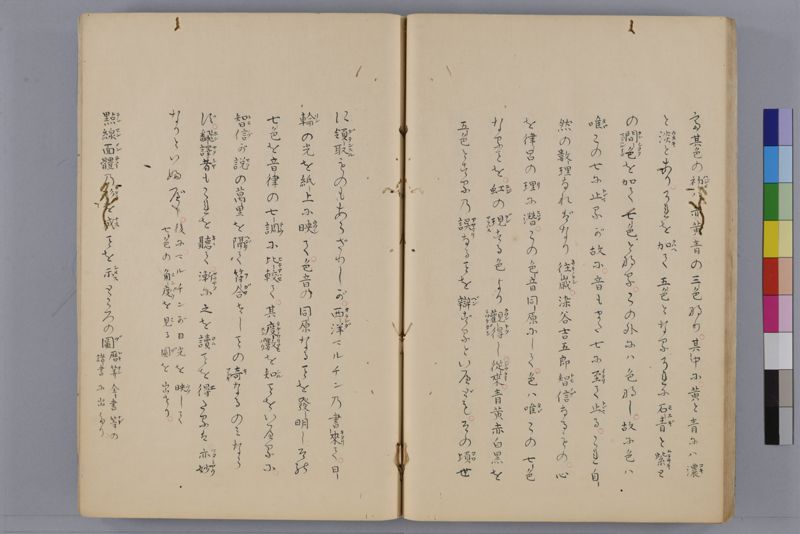
翻刻
て其色の初(ハジメ)は。赤、黄、青の三-色なり。其-中に。黄と青には濃(コキ)
と淡(ウスキ)とあり。それを加(クハヘ)て五-色となる。それに《振り仮名:石-青|モエギ》と紫(ムラサキ)と
の《振り仮名:間-色|カンシヨク|マジハルイロ》を加て七-色となる。この外には色なし。故に色は
唯この七に止(トヾマ)るが故に。音もまた七に至(イタリ)て止(トヾマ)る。これ自-
然の数-理なればなり 《振り仮名:往-歳|サキノトシ》。染谷吉五郎 智信(トモノブ)なるもの。心
を律-呂の理(リ)に潜(ヒソメ)。この色-音 同-原にして。色は唯(タヾ)この七-色
なることを。虹(ニジ)の《振り仮名:現|ゲン|アラハス》する色より《振り仮名:観-得|クワントク|ミツケダシ》し。《振り仮名:従-来|ジウライ》。青黄赤白黒を
五-色とするの誤(アヤマリ)なることを弁(ベン)ずるといへども。その頃(コロ)世
に《振り仮名:領-取|ガテンスル》ものもあらざりしが。《振り仮名:西-洋|オランダ》マルチンの書-来(キタリ)て。日-
輪(リン)の光を紙-上に映(ウツシ)て。色音の同-原なるを発-明しその
七-色を音-律の七-調(テウ)に《振り仮名:比-較|ヒキアハセ》て。其《振り仮名:度-数|タケノワリアヒ|スンパウ 》を知(シル)ことをいへるに。
智信(トモノブ)が説(セツ)の万-里を隔(ヘダテ)て。《振り仮名:符-合|フガフ》せしことの奇(キ|フシギ)なるのみなら
ず。《振り仮名:飜-訳-者|ホンヤクシヤ》もこれを聴(キヽ)て。漸(ヤウヤク)に之を読(ヨム)ことを得(エ)たるは。亦(マタ) 妙(ミヤウ)
なりといふべし。《割書:後に。マルチンが日光を映(ウツ)して|七-色の《振り仮名:角-度|スンパウ》を見(ミ)る図(ヅ)を出せり。》
点線面体(テンセンメンテイ)の形(カタチ)を成(ナス)ことを示(シメス)ところの図(ヅ)《割書:暦算(レキサン)全⁻書 等(ナド)の|諸-書に出たり。》
現代語訳
その色の始まりは、赤・黄・青の三色である。その中で、黄と青には濃いものと淡いものとがある。それを加えて五色となる。さらに萌黄(石青)と紫の間色を加えて七色となる。この他には色はない。ゆえに色はただこの七色にとどまるのであるから、音もまた七に至ってとどまる。これは自然の数理によるものである。
先年、染谷吉五郎智信という者が、心を律呂の理に深く傾け、この色と音が同一の根源を持ち、色はただこの七色に過ぎないということを、虹が現す色から見出した。従来、青・黄・赤・白・黒を五色とするのは誤りであると論じたものの、その頃は世間でこれを理解・納得する者もいなかった。
ところが、西洋(オランダ)のマルチンの書が伝来して、太陽の光を紙上に映して色と音が同一の根源であることを明らかにし、その七色を音律の七調に比較して、その度数(寸法・割合)を知ることを述べているのを見るに、智信の説が万里を隔てて符合したことの不思議さのみならず、翻訳者もこれを聞いて、ようやくこれを読むことができたのは、また妙なることというべきである。【後に、マルチンが日光を映して七色の角度(寸法)を見る図を掲載する。】
点・線・面・体の形を成すことを示す図【暦算全書などの諸書に出ている。】
英語訳
The origin of colors begins with three: red, yellow, and blue. Among these, yellow and blue each have dark and light variations, which when added give five colors. To these, the intermediate colors of moss green (stone blue) and purple are added, yielding seven colors. Beyond these, there are no other colors. Therefore, since colors stop at exactly these seven, musical tones too reach seven and stop there. This is due to the natural principles of numbers.
In a previous year, a man named Someya Kichigoro Tomonobu deeply immersed himself in the principles of pitch and musical tuning (ritsuryō), and discovered from the colors that appear in a rainbow that color and sound share the same origin, and that colors number only these seven. He argued that the conventional view of five colors—blue, yellow, red, white, and black—was in error. However, at that time there was no one in the world who would accept this idea.
Then, a book by the Westerner (Dutch) "Marutin" (Martin) arrived in Japan, which described projecting sunlight onto paper to demonstrate that color and sound share the same origin, and compared the seven colors to the seven modes of musical tuning to determine their proportional measurements. Not only was it remarkable that Tomonobu's theory, separated by ten thousand leagues, turned out to accord perfectly with this work, but it is also wonderful to note that the translator, upon hearing this, was at last able to read (and understand) it.
[Note: Later in this work, a diagram is included showing how Martin projected sunlight to observe the angular measurements of the seven colors.]
A diagram illustrating how the forms of point, line, surface, and solid are constituted. [This appears in various works such as the Rekisan Zensho (Complete Book of Calendar Mathematics) and others.]