翻刻
甲
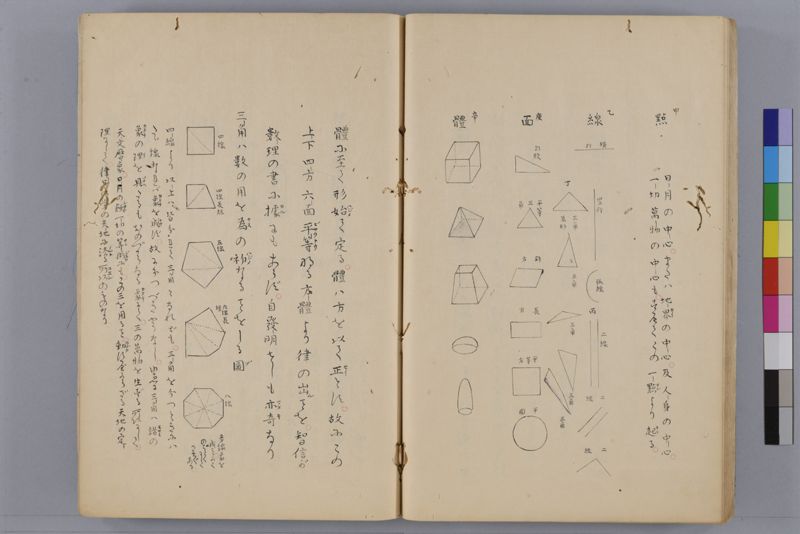
点・ 日-月の中-心。または地-界(カイ)の中-心。人-身の中-心。
一-切 万-物の中-心も。すへてこの一-点(テン)より起(オコ)る。
乙 丙
線 横行 竪行 弧線 二線【竪】 二線【斜】 二線【折線】
丁
三角 為形 三角【縦長二等辺】 三角【横長二等辺】 三角
庚
面 句股 平等三角 斜方 長方 平等方 平円
辛
体
体に至て形 始(ハジメ)て定る。体は方を以て正(セイ)とす。故にこの
上-下 四-方 六-面《振り仮名:平等|ビヤウトウ》なる方-体より律の出 ̄ルことを。智信が
数-理の書に拠(ヨル)にもあらず。自 発-明せしも亦(マタ)奇(キ)なり
三-角は数の用を為(ナス)の初(ハジメ)なることをしる図(ヅ)
四線 四線長短 五線 六線長短 八線 《割書:多線象を|成こと。かく|のごとく|にして|さま〴〵|あり。》
四-線より以-上は皆分れて三-角となれども。三-角を分つときには
たゞ線なれば象(カタチ)を成(ナサ)ず。故に分つべきやうなし。ゆゑに三-角は諸(モロ〳〵)の
象(カタチ)の理(リ)を具(ソナヘ)たるもおのづからなる象(カタチ)にて。三の万物を生ずる所-以にして。
天-文 暦-象。日-月の蝕(シヨク)。一切の《振り仮名:算-術|サンジユツ》にも。この三を用ること。動(ウゴカ)すべからざる天-地の定-
理にして。律-呂の学の天-地に法(ノツト)る所以(ユエン)のものなり。
現代語訳
【甲】
点 日・月の中心、あるいは大地の中心、人体の中心、一切万物の中心も、すべてこの一点より起こる。
【乙】 【丙】
線 横行・縦行・弧線 二線【縦】 二線【斜め】 二線【折れ線】
【丁】
三角 形をなすもの 三角【縦長二等辺】 三角【横長二等辺】 三角
【庚】
面 句股(直角三角形)・平等三角・斜方・長方・平等方・平円
【辛】
体
体に至って、形は初めて定まる。体は「方」(立方体)をもって正(基本)とする。ゆえに、この上下・四方・六面が均等である方体(立方体)より律が生じることを、智信が数理の書によったわけでもなく、自ら発明したのも、また奇妙なことである。
三角は数の用をなすことの始まりであることを示す図
四線・四線長短・五線・六線長短・八線
(多くの線が象(かたち)を成すこと、かくのごとくにして様々あり。)
四線以上はすべて分かれて三角となるが、三角を分かつときにはただ線となるばかりで形をなさない。ゆえに、これ以上分けることはできない。したがって三角は、もろもろの形の理(ことわり)を備えた、おのずからなる形であって、三が万物を生じる所以である。天文・暦象、日月の食(しょく)、一切の算術においても、この三を用いることは、動かすべからざる天地の定理であって、律呂の学が天地に法る所以のものである。
英語訳
**[A] Point**
The center of the sun and moon, or the center of the earth, the center of the human body, and the center of all things in creation — all arise from this single point.
**[B]** (Left section) **[C]** (Right section)
Line: horizontal line, vertical line, arc line | Two lines [vertical] · Two lines [diagonal] · Two lines [broken/bent]
**[D]**
Triangle: forming a shape · Triangle [tall isosceles] · Triangle [wide isosceles] · Triangle
**[G] (Geng)**
Plane: right-triangle (gou-gu) · equilateral triangle · rhombus · rectangle · square · circle
**[H] (Xin)**
Solid
It is only upon reaching the solid that form is truly determined. Among solids, the cube (the "square solid") is taken as the standard. Therefore, the fact that musical tuning (ritsu) emerges from this solid body — whose top, bottom, four sides, and six faces are all equal — was discovered independently by Tomonobu, without reference to any mathematical texts; this too is a remarkable thing.
---
**Diagram showing that the triangle is the beginning of all mathematical operations:**
Four lines · Four lines (long and short) · Five lines · Six lines (long and short) · Eight lines
*(The way in which multiple lines form figures is varied, as illustrated here.)*
Any figure of four lines or more can always be divided into triangles, but when a triangle is divided, it yields only lines and no longer forms a shape. Therefore, it cannot be divided further. Thus the triangle is a naturally occurring form that inherently contains within it the principles of all shapes. This is the reason why three gives rise to all things. In astronomy, calendar science, solar and lunar eclipses, and all forms of arithmetic, the use of this number three is an immutable principle of heaven and earth, and it is the very reason why the study of musical tuning (ritsuryō) takes heaven and earth as its model.