翻刻
むるものにして。その之を弾(ヒキ)これを打(ウツ)にも。《振り仮名:自具|オノヅカラソナハリ》たる度(タケ)-
の外に出ず。物の《振り仮名:無‐妄|ムバウ|イツハリナキ 》なる理(リ)を知(シル)に足(タ)れるものなり。其《振り仮名:他|ホカ》
人《振り仮名:畜|チク》。鳥《振り仮名:蟲|ムシ》。一-切の《振り仮名:音-声|オンジヤウ》を発するも。悉(コト〴〵ク)この数-理より生ず
ることを発-明すべし。然(シカル)ときには。天-下の事。大-小となく。《振り仮名:万|バン|サマ〴〵》-
《振り仮名:殊|シユ|ニワカレテ》にして《振り仮名:一-本||モトハヒトツ》なるは。唯(タダ)これ一-理の《振り仮名:貫-通|クワンンツウ》なり。《振り仮名:所_レ謂|イハユル》一-理
とは。いかなるものを指(サシ)て言(イフ)となれば。直(タヾチ)に是(コレ)天-道の《振り仮名:至|シ|マ》-
《振り仮名:誠 |セイ |コト 》なる。浩-然の気の感と応とによるものなり。故に律-呂
の《振り仮名:小-伎| ギ|チヒサキワザ》 なるも。之を学(マナ)ばむには。唯(タヾ)この浩-然の気を養(ヤシナ)ふべ
き術(ジユツ)を修(オサ)め。天-人合-一なる《振り仮名:真理|シンリ|マコトノスヂミチ 》を 《振り仮名:観得|クワントク|ミツケウル 》するにいたるとき
に。音-楽もまた以て天-下国-家を治(オサム)べし。もし然(シカ)るときに
は。此浩-然の気の万⁻物に渉(ワタリ)て其用を為(ナス)も。豈(ア二)亦(マタ)大(オホヒ)なるも
のならずや
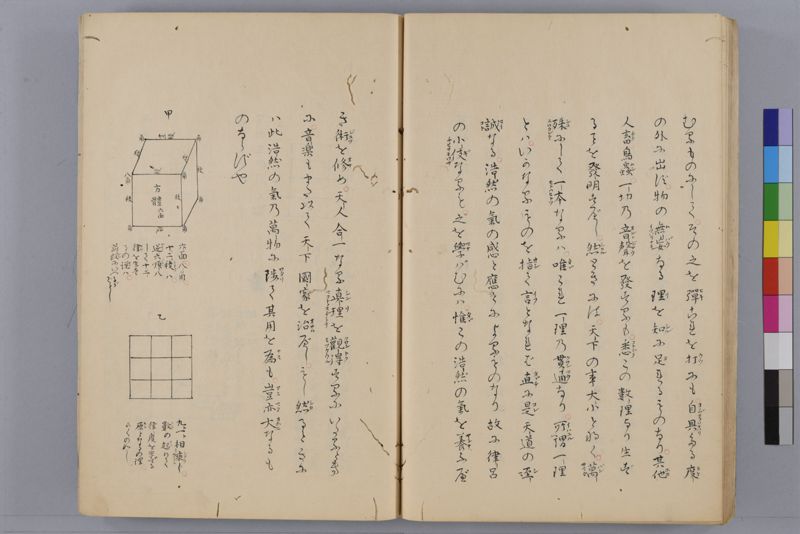
【図形略】
甲 六₋面、八⁻角、 乙 九 ̄ト一 ̄ト相⁻《振り仮名:乗|シヨウ|カケアヒ 》じ。
十⁻二⁻稜は。 数(スウ)の起(オコ)りて
逆(ギヤク)⁻六 順(ジユン)⁻八 律-度を生ずる
して十⁻二⁻ 原(モト)となるの理。
律(リツ)を生す かくの如し。
るの説(セツ)は。
前⁻段(ダン)にいへるが
ごとし
現代語訳
(前頁より続き)……せるものであって、それを弾いたり打ったりするにも、自然に備わった音域(度)の外には出ない。これは、物事に偽りのない(無妄の)理を知るに足るものである。その他、人・家畜・鳥・虫、一切の音声を発するものも、ことごとくこの数理より生ずることを明らかにすべきである。そうであるならば、天下の事は、大小を問わず、万に分かれてもその本はひとつであることは、ただこれ一理の貫通によるものである。いわゆる「一理」とは、いかなるものを指して言うかといえば、直ちにこれは天道の至誠(極めて誠実なること)なる、浩然の気の感と応とによるものである。ゆえに律呂(音楽)という小さき業であっても、これを学ぶには、ただこの浩然の気を養う術を修め、天人合一なる真の道理を見いだすに至るときに、音楽もまた天下・国家を治めるに足るものとなる。もしそのようであるならば、この浩然の気が万物にわたってその働きをなすことは、あにまた大いなるものではないか。
【図の説明】
甲:六面・八角・十二稜は、逆六・順八にして十二律を生ずるという説は、前段に述べたとおりである。
乙:九と一とが相乗じ、数が起こって律度を生ずる原理となる理は、かくのごとし。
英語訳
(Continuing from the previous page) …these are things that bring it about — and even in plucking or striking them, one does not go beyond the range (*take*, degree/extent) that is naturally endowed within the instrument. This is sufficient to allow one to know the principle of *mumō* (無妄, non-deception; the genuine, unfeigned nature) inherent in all things. Furthermore, it should be made clear that the sounds produced by all other beings — humans, domestic animals, birds, insects, and every manner of vocal utterance — likewise arise entirely from these numerical principles. If that is so, then the fact that all affairs under heaven, whether great or small, divide into ten thousand forms yet share a single origin, is nothing other than the pervasion of this one principle (*ichiri*). What is meant by this "one principle"? It refers directly to the *至誠* (*shisei*, utmost sincerity) of the Way of Heaven — that which arises from the stimulus and response (*kan to ō*, resonance and reaction) of the vast, all-pervading *haoranzhiqi* (浩然の気, *kōzen no ki*: the great moral force/vital energy). Therefore, even in so minor an art as the study of *ritsu-ryo* (音律, musical temperament and tuning), to learn it one should cultivate this *kōzen no ki*, and when one reaches the point of perceiving the true principle (*shinri*) of the unity of Heaven and humanity (*ten-jin gōitsu*), then music too will become capable of governing the realm and the nation. If that is indeed so, then is not the *kōzen no ki*, extending across all things and fulfilling its function throughout, truly something great?
【Diagrams (abbreviated in the original)】
**Diagram A (甲):** The six faces, eight vertices, and twelve edges — "reverse-six, forward-eight" (*gyaku-roku, jun-hachi*), generating the twelve pitch-pipes (*jūni-ritsu*) — this explanation is as stated in the preceding section.
**Diagram B (乙):** The principle by which nine and one multiply together (*sōjō*), and numbers arise to become the origin that generates the tuning measures (*ritsudo*), is as shown here.