翻刻
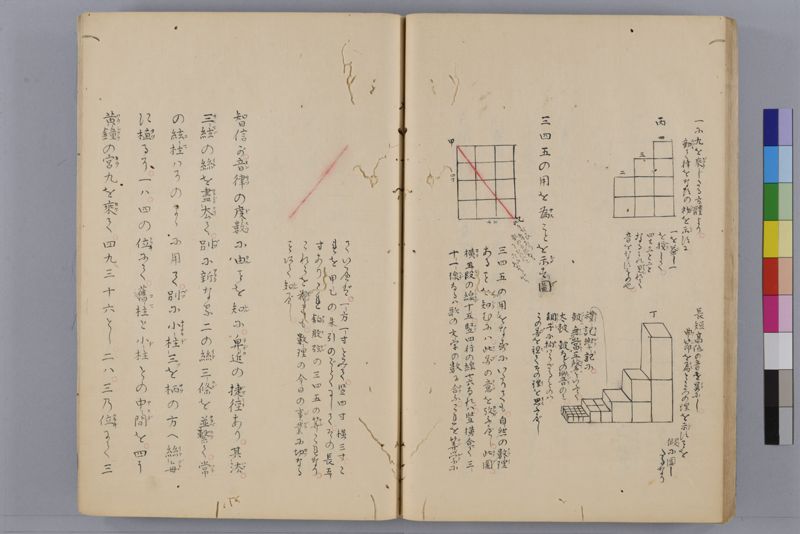
一に九を乗(ジヨウ)じたる方-体より。 長短高低の音を異(コト)にし。
動(ウゴキ)て律をなすの初(ハジメ)を示(シメ)すに。 《振り仮名:曲-節|フシ》を為(ナス)ところの理を示(シメ)
一を益(マ)し一 すことを。
丙 を損(ヘラ)して 丁 仮(カリ)に図し
四と三と二と たるなり
なる。 これ見(アラハ)れて
音をなすもの也。
《振り仮名:礼-記|ライキ》 ̄ノ《振り仮名:学-記|ガクキ》に。
鼓(ツヾミ) ̄ハ無(ナシ)_レ当(アタルコト)_二 五-声(セイ)_一 ̄ニといふて。
太-鼓 鼓などの響(ヒヾキ)のみ。
《振り仮名:調-子|テウシ》に拘(カヽ)はらざるものは。
三 四 五の用を為(ナス)ことを示(シメ)す図(ヅ) この図(ヅ)を視(ミ)てその理(リ)を思(オモ)ふべし。
【斜め書き】此すぢかひ
五寸あり数の自然なる
ことおのれと
古に
あきらかなり
三 四 五の用をなすにいたりても。自⁻然の《振り仮名:数-理|スウリ》
あることを知(シラ)むには。此(コノ)図(ヅ)の意(コヽロ)を攷(カンガ)ふべし。此(コノ)図(ヅ)。
横(ヨコ)五-段(ダン)の線(イトスヂ)十-五。竪(タテ)四-行の線 十-六なれば。竪横合 ̄セて三-
十-一-線(スジ)なるは。歌の文-字の数に合(カナ)ふ。これを《振り仮名:算-学|サンガク》に
ていへば。一-方 一-寸とみて。竪四寸横三寸。こ
れを甲-乙の朱-引のごとくにして。その長五-
寸あり れ鈎(コウ)股(コ)弦(ゲン)の三 四 五の算これなり。
これらを視(ミ)ても。数-理の今-日の《振り仮名:事-業|ジゲフ 》に切(セツ)なる
こと以て知(シル)べし。
智信が。音律(オンリツ)の《振り仮名:度-数|ドスウ》に由(ヨル)ことを知(シル)に。《振り仮名:卑-近|テヂカ》の 《振り仮名:捷-径|ハヤミチ》あり。其-法(ハフ)。
《振り仮名:三-絃|サンセン》の糸を《振り仮名:尽-去|コト〴〵クトリ》て。別(ベツ)に新(アラタ)なる二の糸三-條(スジ)を《振り仮名:並-繫|ナラベカケ》て。常(ツネ)
の《振り仮名:絃-柱|コマ》はそのまヽに用て。別(ベツ)に《振り仮名:小-柱|チイサキヂ》-三 ̄ッを柄(サヲ)の方へ《振り仮名:糸-毎|イトゴト》
に植(タツ)るに。一は。四の位(クラヰ)にて。《振り仮名:旧-柱|コマ》と《振り仮名:小-柱|ヂ》との《振り仮名:中-間|アヒダ》を。四に
《振り仮名:黄-鐘|ワウシヨウ》の宮(キウ)九を乗(カケ)て。四 九 三 十 六とし。二は。三の位(クライ)にて。三
現代語訳
【丙の図の説明】
一に九を乗じた方体(立方体)から、動いて律をなす始まりを示すにあたり、一を加え一を減じて、四と三と二とが現れて音をなすものである。
【丁の図の説明】
長短・高低の音を異にし、曲節(フシ)をなすところの理を示すことを、仮に図示したものである。
---
『礼記』の「学記」に、「鼓(太鼓)は五声に当たることなし」といって、太鼓・鼓などの響きのみで、調子に拘わらないものは、この図を見てその理を思うべきである。
【斜め書き注記】
この斜め線は五寸あり、数の自然なることは、おのずから古くより明らかである。
---
三・四・五の用をなすにいたっても、自然の数理があることを知るには、この図の意を考えるべきである。この図は、横五段の線が十五本、縦四行の線が十六本であるから、縦横合わせて三十一線であることは、歌(和歌)の文字の数に合う。これを算学(数学)で言えば、一方を一寸とみて、縦四寸・横三寸、これを甲乙の朱引き(赤線)のようにして、その長さが五寸ある。これが鈎(こう)・股(こ)・弦(げん)の三・四・五の算(ピタゴラスの定理)というものである。これらを見ても、数理が今日の事業(実際の学問・営み)に切要であることを、もって知るべきである。
---
智信(著者・平野重誠の号)が、音律の度数によることを知るに、手近な近道がある。その方法は次のとおりである。三絃の糸をすべて取り去って、別に新しい二番目の糸を三条並べかけて、通常の絃柱(こま)はそのままに用い、別に小柱(ちいさきじ)三つを棹(さお)の方へ糸ごとに立てるのであるが、一は、四の位(くらい)にて、旧柱(こま)と小柱(じ)との中間を、四に黄鐘の宮(キウ)九を乗じて四九・三十六とし、二は、三の位(くらい)にて、三……(以下次頁へ続く)
英語訳
**[Diagram C (丙) — Explanation]**
Starting from the cubic form (*hōtai*) obtained by multiplying one by nine, to show the beginning of its movement in forming the *ritsu* (pitch-pipes/musical scales): by adding one and subtracting one, four, three, and two emerge — these are what become sound.
**[Diagram D (丁) — Explanation]**
This is a provisional illustration showing the principle by which sounds of differing length, brevity, high pitch, and low pitch come to form musical phrases (*fushi*).
---
In the *Gakki* ("Record of Learning") section of the *Liji* (礼記, *Book of Rites*), it is said: "The drum has no correspondence among the five tones (*goshō*)." That is, the sounds of the large drum (*taiko*) and hand drum (*tsuzumi*), which are not constrained by any particular pitch or key, should be contemplated in light of this diagram and its underlying principle.
**[Diagonal annotation]**
This diagonal line is five *sun* in length. That numbers possess this natural quality has been self-evidently clear since ancient times.
---
Even in reaching the application of three, four, and five, to know that there exists a natural mathematical principle (*sūri*), one should reflect carefully on the meaning of this diagram. In this diagram, there are fifteen horizontal lines arranged in five tiers, and sixteen vertical lines arranged in four columns, making thirty-one lines in total when horizontal and vertical are combined — a number which coincides with the count of characters (*mojikazoku*) in a *waka* poem. Stated in terms of mathematics (*sangaku*): if one side is taken as one *sun*, then vertical is four *sun* and horizontal is three *sun*; drawn with red lines (*shubiki*) as in Diagrams A and B (*kō-otsu*), the hypotenuse (*gen*) measures five *sun* in length. This is precisely the "three-four-five" calculation of the *gōkoGen* (勾股弦) — that is, the right-triangle theorem (analogous to the Pythagorean theorem). From these observations too, one can know how essential mathematical principles are to the practical work and learning of the present day.
---
I, Chishin (智信, the author Hirano Shigeshige's literary name), have found a convenient and accessible shortcut (*hayamichi*) by which one can come to understand that musical temperament (*onritsu*) depends upon numerical ratios (*dosū*). The method is as follows: Remove all the strings from a *sangen* (三絃, three-stringed instrument; *shamisen*), and in their place affix three strands of a new second type of string side by side. The regular bridge (*koma*) is used as it is, but in addition three small bridge-pieces (*chiisaki ji*) are inserted — one per string — toward the neck (*sao*). The first is placed at the position of "four": the interval between the old bridge (*koma*) and the small bridge (*ji*) is calculated by multiplying four by nine (the *gong* [宮, fundamental tone] of *Huangzhong* [黄鐘, *Ōshō*]), yielding four times nine equals thirty-six. The second is placed at the position of "three": [multiplied by] three... *(continues on the next page)*