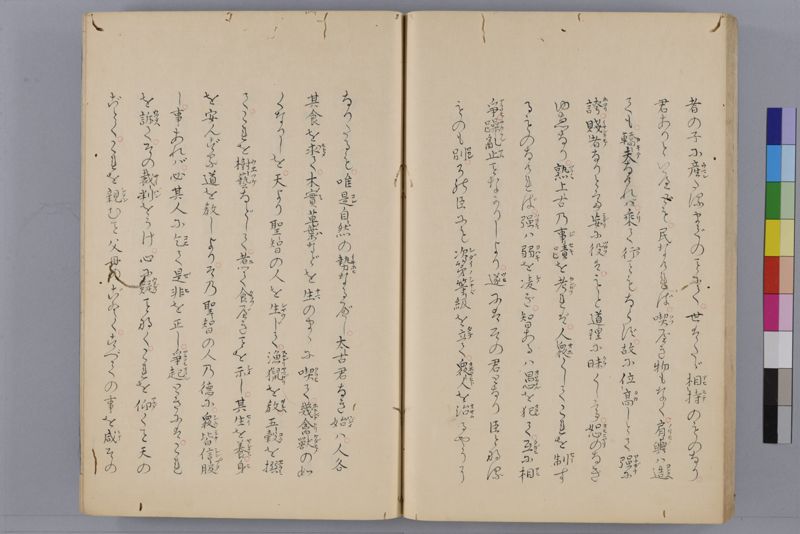
翻刻
【右丁】
者の子に産(ウマレ)たるまでのことにて。世はたゞ相(アヒ)₋持(モチ)のものなり。
君ありといへども。民なければ。喫(クフ)べき物もなく。《振り仮名:肩⁻輿|ノリモノ》は造(コシラヘ)
ても。《振り仮名:轎⁻夫|カキテ》なければ。乗(ノリ)て行(ユク)こともならず。故に位₋高(タカ)しとて強(アナガチ)に
誇(ホコリ)。賤(イヤシキ)₋者(モノ)なりとて妄(ミダリ)に役(ツカフ)は。もと道⁻理に昧(クラ)くして。恕(オモヒヤリ)のなき
ゆゑなり。熟(ツラ〳〵)上⁻古の事(ジ)⁻蹟(セキ)を考(カンガフ)れば。人₋衆(オホ)くしてこれを制(セイ)す
るものなければ。強(ツヨキ)は弱(ヨハキ)を凌(シノ)ぎ。智あるは愚(オロカナル)を犯(オカシ)て。互(タガヒ)に相(アヒ)
争(アラソヒ)。躁(サウ)⁻乱(ラン)止(ヤム)ことなかりしより。遂(ツヒ)にはその君となり臣となる
ものも別(ワカレ)。その臣にも《振り仮名:次⁻第等⁻級|シダイノシナ〴〵》を立(タテ)て。《振り仮名:衆⁻人|オホクノヒト》を治(オサム)るやうに
【左丁】
なりたるも。唯 是(コレ)自⁻然の勢(イキホヒ)なるべし。太⁻古君なき始(ハジメ)は。人各
其食を求(モトメ)て。木 ̄ノ実(ミ)草 ̄ノ葉(ハ)などを生(ナマ)のまゝに喫(クラヒ)て。幾(ホトンド)禽(トリ)⁻獣(ケダモノ)の如
くなりしを。天より聖⁻智の人を生(シヤウ)じて。漁(スナドリ)猟(ヤマガリ)を教(ヲシヘ)。五⁻穀(コク)を撰(ヱラミ)
て。これを《振り仮名:樹⁻芸|ウヱツケ》などして。煮(ニ)て食(クラフ)べきことを示(シメ)し。其 生(セイ)を養(ヤシナヒ)。身(ミ)
を安んずる道を教しより。その聖⁻智の人の徳に。衆(シウ)皆(ミナ)信(シン)⁻服(プク)
し。事あれば。必其人に乞(コヒ)て是非(ゼヒ)を正し。争(アラソヒ)起(オコル)ときには。これ
を訴(ウツタヘ)て。その裁(サイ)⁻判(バン)をうけ。心に疑(ウタガフ)ことなく。これを仰(アフグ)く【衍】こと天の
ごとく。これを親(シタシ)むこと父母のごとく。すべての事を咸(ミナ)その
現代語訳
【右丁】
者の子に生まれたというだけのことで、世はただ相互に支え合うものである。
君主がいるといっても、民がなければ、食べるものもなく、乗り物は作っても、担ぎ手がなければ、乗って行くこともできない。故に地位が高いといって無理に誇り、卑しい者だといって勝手に使役するのは、もと道理に暗くて、思いやりがないからである。つらつら上古の事跡を考えれば、人が多くてこれを制する者がなければ、強い者は弱い者を凌ぎ、智ある者は愚かな者を犯して、互いに相争い、騒乱が止むことがなかったため、ついにはその君となり臣となる者も別れ、その臣にも次第等級を立てて、多くの人を治めるようになった
【左丁】
のも、ただこれ自然の勢いであろう。太古に君主がなかった始めは、人それぞれその食を求めて、木の実や草の葉などを生のまま食べて、ほとんど鳥獣のようであったのを、天より聖智の人を生じて、漁や狩りを教え、五穀を選んで、これを栽培などして、煮て食べることを示し、その生を養い、身を安んずる道を教えてより、その聖智の人の徳に、衆皆が信服し、事があれば、必ずその人に乞うて是非を正し、争いが起こるときには、これを訴えて、その裁判を受け、心に疑うことなく、これを仰ぐこと天のごとく、これを親しむこと父母のごとく、すべての事をみなその
英語訳
【Right page】
born as children of the poor—and the world is simply one of mutual dependence.
Even if there is a lord, without the people, there would be nothing to eat, and even if palanquins are made, without bearers, one cannot ride and travel. Therefore, to arbitrarily boast because one's position is high, or to carelessly use others because they are considered base, stems from being ignorant of moral principles and lacking in compassion. If we carefully consider the historical events of ancient times, when there were many people but no one to govern them, the strong oppressed the weak, the intelligent violated the foolish, they fought against each other, and turmoil never ceased. Eventually, those who became lords and those who became retainers were distinguished, and among the retainers too, hierarchical ranks were established to govern the masses.
【Left page】
This too was simply the natural course of events. In the primordial past when there were no rulers, each person sought their own food, eating nuts and grass leaves raw, living almost like birds and beasts. Then Heaven gave birth to people of sacred wisdom who taught fishing and hunting, selected the five grains, showed how to cultivate them, and demonstrated cooking and eating them, thereby nourishing life and teaching the way to secure one's existence. From that time, the masses all believed in and submitted to the virtue of those people of sacred wisdom. When matters arose, they would always appeal to those people to determine right and wrong; when disputes occurred, they would bring their cases to them and receive their judgments. Without doubt in their hearts, they looked up to them like Heaven and cherished them like parents, entrusting all matters entirely to their