翻刻
一 百人(ひやくにん)一 首(しゆ)は定家(ていか)おぐら山にすみて山庄(さんさう)の障子(しやうし)に色紙(しきし)に
書給ふ百人(ひゃくにん)の名哥(めいか)なり
右は女(をんな)のもてあそふさうしなれば作者(さくしや)をしらしむるなり
㊃琴(こと)をたんずる事
三味線(さみせん)はりうきう国(こく)よりわが朝(てう)にわたりたれともその音(おと)
淫乱(いんらん)にして楽器(がくき)にいらず遊女(ゆうぢよ)のわざとなれりゆめ〳〵
引(ひき)ならひ給ふべからずされどもその所(ところ)〳〵の名(な)はおぼへ給ふべし
一たう 一さほ 一かいらうび《割書:さほの上かゞみたる|所ゑひににたれは》
一いとくち《割書:いとのまき|たる内也》 一てんじゆ《割書:いとまく|くし也》 一ねを《割書:いとをくゝり付る所|こより水引などにてする也》
一さるを《割書:ねをゝ引かけ|おゝさほのさき》 一ちぶくろ《割書:さほの下|ふくれたる所》 一《割書:こま|ばち》
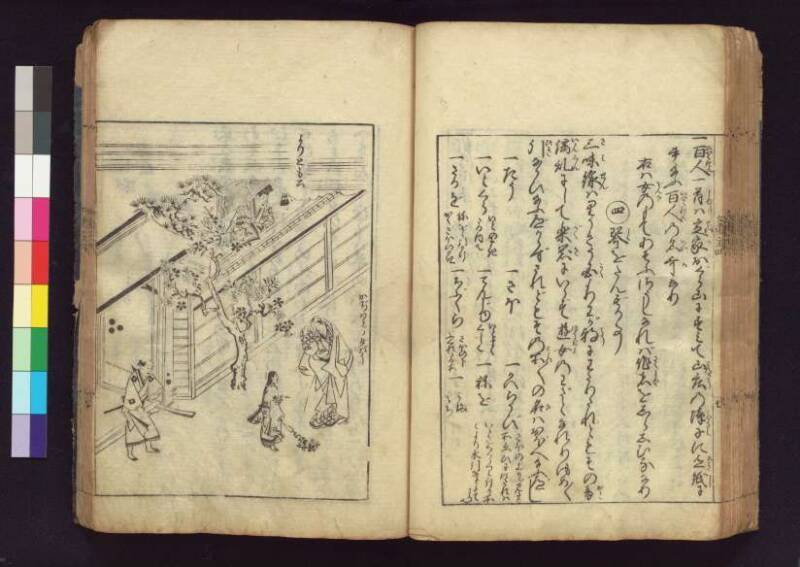
【図の説明】
かぢはらが女ばう
よりとも公
現代語訳
一 百人一首は定家が小倉山に住んで山荘の障子に色紙に書き給う百人の名歌なり
右は女のもてあそぶ草子なれば作者を知らしめるなり
㊃琴を弾ずる事
三味線は琉球国よりわが朝にわたりたれどもその音淫乱にして楽器に入らず遊女の業となれり夢々引き習い給うべからずされどもその所々の名は覚え給うべし
一棹 一竿 一海老尾《竿の上が鏡たる所、笄に似たれば》
一糸口《糸の巻きたる内なり》 一天柱《糸巻く櫛なり》 一猫尾《糸を括り付ける所、紙縒り水引などにてするなり》
一猿尾《猫尾を引かけ大竿の先》 一乳袋《竿の下ふくれたる所》 一駒・撥
【図の説明】
梶原が女房
頼朝公
英語訳
1. Hyakunin Isshu (One Hundred Poems by One Hundred Poets) consists of one hundred famous poems by one hundred poets that Teika wrote on colored paper and pasted on the sliding doors of his mountain villa when he lived on Mount Ogura.
The above are reading materials for women's entertainment, so the authors are identified.
㊃On Playing the Koto
The shamisen was brought to our country from the Ryūkyū Kingdom, but its sound is lascivious and is not included among proper musical instruments, having become the trade of courtesans. You should absolutely never learn to play it. However, you should remember the names of its various parts:
One tō (neck) One saho (neck/rod) One kairōbi (tailpiece) 《The curved part at the top of the neck, so called because it resembles a kōgai (hairpin)》
One itokuchi (string aperture) 《The interior where strings are wound》 One tenju (tuning peg) 《The comb for winding strings》 One neko (cat tail) 《The place where strings are tied, done with twisted paper, mizuhiki cord, etc.》
One saru-o (monkey tail) 《Hooking the cat tail to the tip of the large neck》 One chibukuro (chin bag) 《The swollen part below the neck》 One koma (bridge) and bachi (plectrum)
[Illustration caption]
Kajiwara's wife
Lord Yoritomo