翻刻
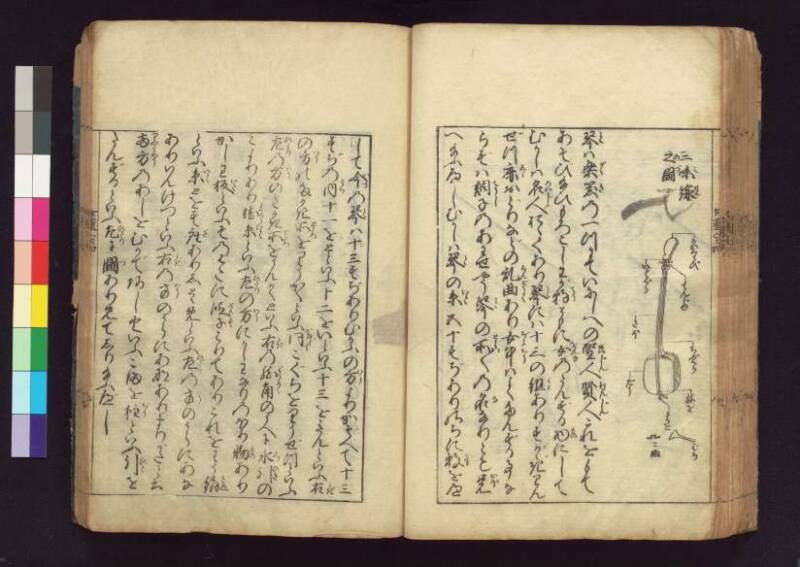
【図の説明】
三 味線(みせん)
之図(のづ)
かいらうび
いとぐち
てんじゆ
さほ
ちぶくろ
だう
ねを
さるを
ばち
こま
琴(こと)は楽器(がくき)の一つにていにしへの聖人(せいじん)賢人(けんじん)これをもて
あそび給ひもろこしわが朝(てう)ともに女(をんな)のたんずる物(もの)にして
むかしは名人(めいじん)おゝくあり琴(こと)には十三の組(くみ)ありすがゞきりん
ぜつ鹿(しゝ)おどりなどの乱曲(らんぎよく)あり女中(ぢよちう)はよくたんずる事な
らずは調子(てうし)のあわせやう琴(こと)の所(ところ)〳〵の名(な)なりとも覚(おほ)
へ給ふへしむかしは琴(こと)の糸(いと)五十すぢありのちに数(かす)をへ
して今(いま)の琴(こと)は十三すぢありむかふの方(はう)よりかぞへて十三
すぢの内(うち)十一をとといふ十二をいといふ十三をきんといふ右(みぎ)
の方(はう)のたかき所(ところ)をりうかくといふ同(おなじく)こぐちをりうぜつといふ
左(ひたり)の方(はう)のたかき所(ところ)をうんかくといふ右(みき)の竜角(りうかく)のうへに水引(みづひき)の
こよりあり枕糸(まくらいと)といふ左(ひだり)の方(はう)にかしわなりのほり物(もの)あり
かしわ板(いた)といふそのはたに段子(とんす)はりてありこれをわう絹(ぎぬ)
といふ糸(いと)とをす座(ざ)ありしとゝめといふ左(ひだり)の方(はう)のうらにあな
ありいんけつといふ右(みぎ)の方(はう)のうらにあなありまりがたと云
両方(りやうはう)のあしをむかであしといふこまを柱(ぢう)といふ引(ひく)を
たんずるといふ左(ひたり)に図(づ)あり見てしり給ふべし
現代語訳
【図の説明】
三味線の図
海老尾
糸口
天柱
竿
乳袋
胴
猫尾
猿尾
撥
駒
琴は楽器の一つで、いにしえの聖人賢人がこれで遊び給い、中国でもわが国でも共に女性が弾ずる物で、昔は名人が多くありました。琴には十三の組があり、菅垣、輪舌、鹿踊りなどの乱曲があります。女性は上手に弾くことができなくても、調子の合わせ方や琴の各部分の名前なりとも覚えなさい。昔は琴の糸が五十筋ありましたが、後に数を減らして今の琴は十三筋あります。向こうの方から数えて十三筋の内、十一を「と」という、十二を「い」という、十三を「きん」といいます。右の方の高い所を「竜角」といい、同じく小口を「竜舌」といいます。左の方の高い所を「雲角」といいます。右の竜角の上に水引の紙縒りがあり、「枕糸」といいます。左の方に柏なりの彫り物があり「柏板」といいます。その傍に緞子を張ってあり、これを「王絹」といいます。糸を通す座があり「糸止め」といいます。左の方の裏に穴があり「陰穴」といいます。右の方の裏に穴があり「丸形」といいます。両方の脚を「向かえ脚」といいます。駒を「柱」といいます。弾くことを「弾ずる」といいます。左に図があります、見て知りなさい。
英語訳
[Illustration caption]
Diagram of the Shamisen
Kairōbi (tailpiece)
Itokuchi (string aperture)
Tenju (tuning peg)
Saho (neck)
Chibukuro (resonator bulge)
Dō (body)
Neko (cat tail)
Saru-o (monkey tail)
Bachi (plectrum)
Koma (bridge)
The koto is one of the musical instruments that ancient sages and wise men played for entertainment. In both China and our country, it is an instrument played by women, and there were many master players in the past. The koto has thirteen tunings, with irregular pieces such as Sugagaki, Rinzetsu, and Shika-odori. Even if women cannot play skillfully, they should at least learn how to tune it and memorize the names of the various parts of the koto. In ancient times, the koto had fifty strings, but later the number was reduced, and today's koto has thirteen strings. Counting from the far side, among the thirteen strings, the eleventh is called "to," the twelfth is called "i," and the thirteenth is called "kin." The raised part on the right side is called "ryūkaku" (dragon horn), and similarly, the small opening is called "ryūzetsu" (dragon tongue). The raised part on the left side is called "unkaku" (cloud horn). Above the right dragon horn, there is a twisted paper cord of mizuhiki called "makura-ito" (pillow string). On the left side, there is a carving in the shape of an oak leaf called "kashiwa-ita" (oak board). Beside it, damask is stretched, which is called "ō-ginu" (royal silk). There is a seat where strings pass through called "ito-todome" (string stopper). On the back left side, there is a hole called "inketsu" (yin hole). On the back right side, there is a hole called "marigata" (round shape). Both legs are called "mukae-ashi" (receiving legs). The bridges are called "hashira" (pillars). Playing is called "tanzu." There is a diagram on the left; please look at it to understand.