翻刻
【図の説明】
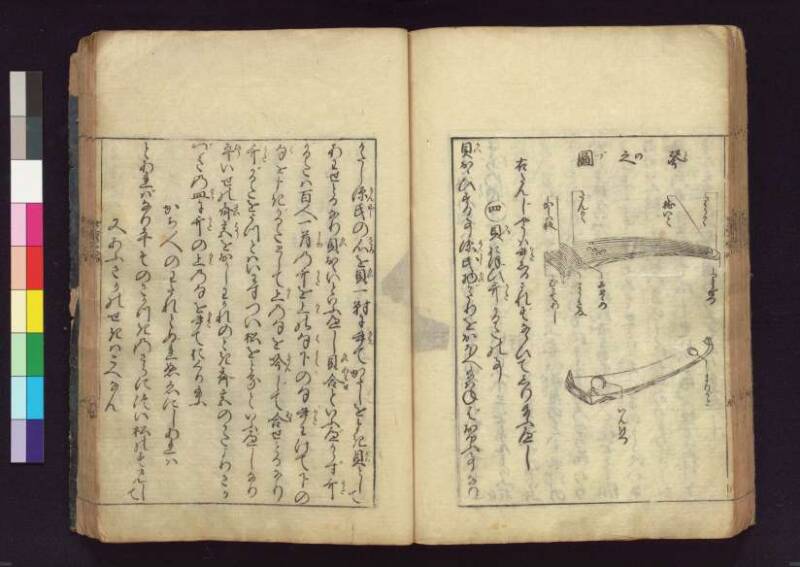
【横書】琴之図(ことのづ)
りうかく
枕いと
うんかく
かしは板
りうぜつ
左とゝめ
わうきぬ
むかであし
まりがた
いんけつ
右たんじやうは書(かき)しるされずならひてしり給ふべし
㊃貝(かい)おほひ哥(うた)かるたの事
貝(かい)おゝひする事 源氏物(げんじもの)がたりをおほへ給はねばおほふ事なり
かたし源氏(けんじ)の心(こゝろ)を貝(かい)一対に書(かき)てかた〳〵をまき貝(かい)として
あわせとるなり貝(かい)おゝいといふへし貝合(かいあわせ)といふべからず哥(うた)
がるたは百人一 首(しゆ)の哥(うた)を上(かみ)の句(く)下(しも)の句(く)書(かき)わけて下の
句(く)をまきがるたとして上(かみ)の句を吟(きん)じて合(あわ)せとるなり
哥(うた)がるたをうつとはいわすつい松をとるといふべしなり
平(ひら)いせの斉宮(さいくう)をおかしわかれのとき斎宮のかたよりさか
づきの皿(さら)に哥(うた)の上(かみ)の句を書(かき)ておくり給ふ
かち人のわたれとぬれぬゑにしあれは
とあればなり平そのさかつきのさらについ松のすみして
又あふさかのせきはこへなん
現代語訳
【図の説明】
【横書】琴の図
竜角
枕糸
雲角
柏板
竜舌
糸止め
王絹
向かえ脚
丸形
陰穴
右の弾奏法は書き記されていないので、習って知りなさい。
㊃貝覆い・歌かるたのこと
貝覆いをすることは、源氏物語を覚えていなければ覆うことは難しいものです。源氏の絵柄を貝一対に描いて、それぞれを蒔絵の貝として合わせ取るのです。「貝覆い」というべきで、「貝合わせ」というべきではありません。歌かるたは百人一首の歌を上の句と下の句に書き分けて、下の句を蒔絵のかるたとして、上の句を吟じて合わせ取るのです。歌かるたを「打つ」とは言わず、「つい松を取る」というべきです。
平清盛が伊勢の斎宮を愛しく思い、別れの時に斎宮の方から盃の皿に歌の上の句を書いて送りました。
「勝つ人の渡れと濡れぬ縁しあれば」
とありました。平清盛はその盃の皿に対して墨で、
「また逢う坂の関は越えなん」
英語訳
[Illustration caption]
[Horizontal text] Diagram of the Koto
Ryūkaku (dragon horn)
Makura-ito (pillow string)
Unkaku (cloud horn)
Kashiwa-ita (oak board)
Ryūzetsu (dragon tongue)
Ito-todome (string stopper)
Ō-ginu (royal silk)
Mukae-ashi (receiving legs)
Marigata (round shape)
Inketsu (yin hole)
The playing techniques on the right are not written down, so you should learn them through practice.
㊃ About Shell Covering and Poem Cards
Playing shell covering is difficult unless you have memorized the Tale of Genji. Pictures from the Genji are painted on pairs of shells, and each half is made into a lacquered shell to be matched and taken. It should be called "kai-ōi" (shell covering), not "kai-awase" (shell matching). For poem cards, the poems of the Hundred Poets are written separately as upper and lower verses, with the lower verses made into lacquered cards, and players chant the upper verse to match and take the corresponding card. You should not say "strike" the poem cards, but rather say "take the accompanying pine."
When Taira no Kiyomori fondly parted from the Saigū of Ise, the Saigū sent him the upper verse of a poem written on a sake cup plate:
"Though the victor crosses, the bond remains unwetted"
In response, Taira wrote with ink on that same sake cup plate:
"We shall meet again and cross the barrier of Ōsaka"