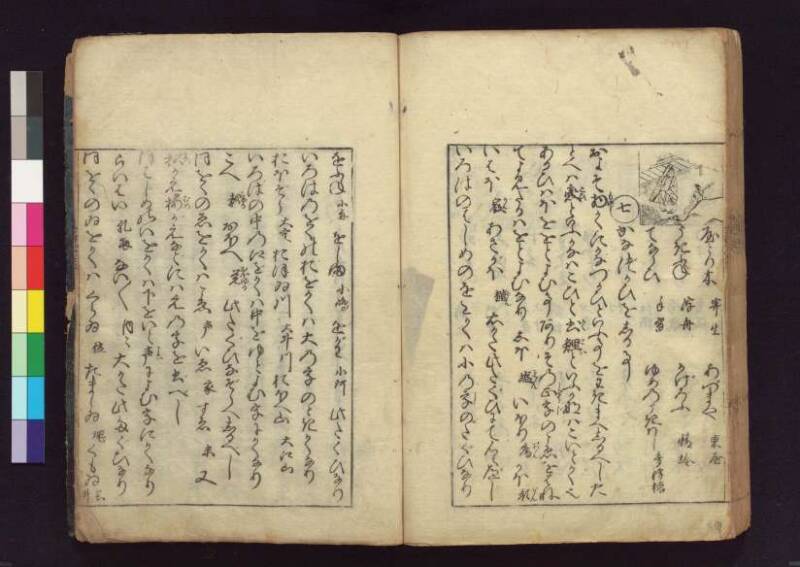
翻刻
やとりき《割書:寄生|》 あづまや《割書:東屋|》
うきふね《割書:浮舟|》 かげろふ《割書:蜻蛉|》
てならひ《割書:手習|》 ゆめのうきはし《割書:夢浮橋|》
㊆かなづかひをしる事
およそ物(もの)かくにかなづかひといふ事をわきまへしるへした
とへは恋(こひ)といふかなはこひと書(かく)鯉(こい)といふかなはこいとかく也
あるひはほををとよむ事なりその正字(しやうじ)のこゑをはね
てよみたるはをとよむなり しほ《割書:塩(えん)|》 いほり《割書:庵(あん)|》 かほ《割書:顔(がん)|》
いはほ《割書:巌(がん)|》 あさがほ《割書:槿(きん)|》 右かた此たぐひにて心へべし
いろはのはしめのををかくは小の字(し)のたぐひなり
をふね《割書:小舟|》 をしま《割書:小嶋|》 をがわ《割書:小河|》 此たくひなり
いろはのをくのおをかくは大の字のときかくなり
おほぞら《割書:大空|》 おほゐ川《割書:大井川|》 おほへ山《割書:大江山|》
いろはの中のえをかくは中をゆとよむ字にかくなり
こへ《割書:越(こゆる)|》 おぼへ《割書:覚(おほゆる)|》 此たぐひなぞらへしるべし
同をくのゑをかくは こゑ《割書:声|》 いゑ《割書:家|》 すゑ《割書:末|》 又
松(まつ)がえ梅(むめ)がえなどにはえの字を書べし
同はじめのいをかくは下をいと声(こゑ)によむ字にかくなり
らいはい《割書:礼拝|》 ない〳〵《割書:内々|》 大かた此たぐひなり
同をくのゐをかくは くらゐ《割書:位|》 たましゐ《割書:魂|》 くもゐ《割書:雲|井》
現代語訳
宿木 東屋
浮舟 蜻蛉
手習 夢浮橋
かなづかいを知ること
およそ文章を書くときに、かなづかいということを理解して知っておくべきである。
たとえば恋(こい)という仮名は「こひ」と書き、鯉(こい)という仮名は「こい」と書くのである。
あるいは「を」と読むことである。その正字の声を撥ねて読んだものを「を」と読むのである。 塩(えん) 庵(あん) 顔(がん)
巌(がん) 朝顔(きん) これらはこの類いであり、このように理解すべきである。
いろはの最初の「を」を書くのは、小の字の類いである。
小舟 小島 小川 この類いである。
いろはの終わりの「お」を書くのは、大の字のときに書くのである。
大空 大井川 大江山
いろはの中の「え」を書くのは、中を「ゆ」と読む字に書くのである。
越える(こゆる) 覚える(おぼゆる) この類いになぞらえて知るべきである。
同じく終わりの「ゑ」を書くのは 声 家 末 また
松が枝、梅が枝などには「え」の字を書くべきである。
同じく最初の「い」を書くのは、下を「い」と声に読む字に書くのである。
礼拝 内々 だいたいこの類いである。
同じく終わりの「ゐ」を書くのは 位 魂 雲井
英語訳
Yadorigi (The Mistletoe) Azumaya (The Eastern Cottage)
Ukifune (A Boat upon the Waters) Kagerou (The Mayfly)
Tenarai (At Writing Practice) Yume no Ukihashi (The Floating Bridge of Dreams)
On Understanding Kana Usage
Generally, when writing texts, one should understand and know about kana usage.
For example, the kana for "koi" (love) is written as "kohi," while the kana for "koi" (carp) is written as "koi."
Or it concerns reading "wo." What is read as "wo" is when the sound of the original character is aspirated. Salt (en) Hermitage (an) Face (gan)
Rock (gan) Morning glory (kin) These are of this type, and should be understood in this way.
Writing "wo" at the beginning of the iroha is of the type of the character "ko" (small).
Small boat Small island Small river These are of this type.
Writing "o" at the end of the iroha is when writing the character for "large."
Great sky Oi River Mt. Oe
Writing "e" in the middle of the iroha is for characters where the middle is read as "yu."
Cross over (koyuru) Remember (oboyuru) These should be understood by analogy with this type.
Similarly, writing "we" at the end is for Voice House End Also
For "matsugae" (pine branch), "umegae" (plum branch), etc., the character "e" should be written.
Similarly, writing "i" at the beginning is for characters where the bottom is read with an "i" sound.
Worship Private matters Generally these are of this type.
Similarly, writing "wi" at the end is for Rank Soul Cloud-dwelling