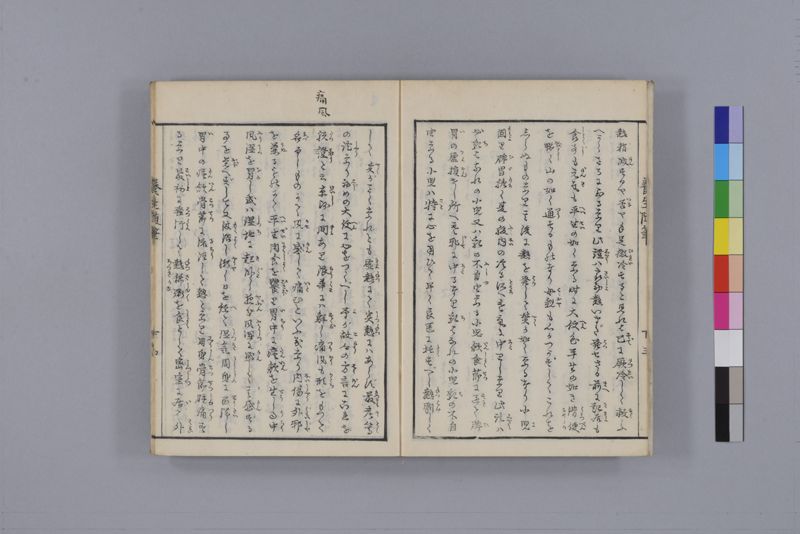
翻刻
【右丁】
熱稍 減(けん)するや否(いな)や手足 微冷(ひれい)すると見れは已(すで)に厥冷(けつれい)して救(すく)ふ
へからさるに至るなり此 證(しやう)は最初(さいしよ)熱いまだ発(はつ)さる前(まへ)に起居(ききよ)も
食事(しよくじ)も元気(げんき)も平生(へいせい)の如くなる時に大 便(へん)色平生の如き潰便(くわつべん|なめらか)
を夥(おびたゝし)く山の如く通(つう)するものなり母親(はゝおや)も心かつうすしてこれを
しらぬものなり其後に熱を発(はつ)して焚(やく)か如くなるなり小 児(に)
固(もとよ)り脾(ひ)胃(い)脆(もろ)く腹内(ふくない)の冷る所(ところ)へ寒気に中(あた)りしなり此 證(しやう)は
必 乳(ち)はなれの小児又は乳の不自由(ふしゆ)なる小児 飲食(いんしよく)節(せつ)に過(すき)て脾(ひ)
胃(い)の虚損(きよそん)せし所へ寒 邪(じや)に中(あた)るなり乳(ち)はなれの小児 乳(ち)の不自
由なる小児は特(こと)に心を用ひて早く良医に托(たく)すべし熱(ねつ)劇(はけ)しく
【左丁】
して焚(やく)がことくなれとも虚熱(きよねつ)にて実熱(しつねつ)にはあらず最(もつとも)危篤(きとく)
の證(しやう)なり初(はじ)めの大 便(へん)に心をつくし予(よ)が故郷(こけう)の方言(はうげん)にこれを
脱證(たつしやう)と云 京師(けいし)に間(まゝ)あり浪華(らうくわ)には鮮(すくな)し痛風(つうふう)も形(かたち)をもつて
名(なづ)るしものにて風(かせ)に感(かん)して痛(いた)むといふ義なり内傷(ないしやう)に外邪(ぐわいじや)
を兼(かぬ)るゝとのにて平生(へいぜい)肉食(にくしよく)を饕(むさぼ)り胃中(いちう)に痰飲(たんいん)を生(せうj)し過中(かちう)
風湿(ふうしつ)を冒(おか)し或は湿地(しつち)に起臥(きぐわ)し夜分(やぶん)風湿(ふうしつ)に感(かん)して其 感(かん)ずる
事を覚(おぼ)へずして又 沐浴(もくよく)し漸(やうや)くひを経(へ)て湿気(しつき)周身(とうしん)留滯(りうたい)し
胃(い)中の痰飲(たんいん)骨節(こつせつ)に流注(るちう)して熱となり周身(しうしん)骨節(こつせつ)腫痛(しゆつう)す
るなり最初(さいしよ)に発汗(はつかん)して熱稀釈(ねつきしやく|あつきかゆ)を食(しよく)として密室(みつしつ)に居(い)て外(くわい)
【左丁三行目頭部欄外】
痛風
現代語訳
【右丁】
熱が少し減ったかどうかというと、手足が微かに冷えるのを見ると、すでに厥冷(手足の冷え)となって救うことができない状態に至る。この症状は最初、熱がまだ発生する前に、起居も食事も元気も平生の通りの時に、大便の色が平生の通りの滑らかな便を非常に多く山のように出すものである。母親も気がつかずにこれを知らないものである。その後に熱を発して燃えるようになる。小児はもともと脾胃が脆弱で、腹内が冷えているところに寒気に当たったのである。この症状は必ず乳離れした小児、または乳の不自由な小児が飲食を節度を過ごして脾胃が虚損した所に寒邪に当たるのである。乳離れした小児や乳の不自由な小児は特に注意して早く良医に託すべきである。熱が激しく
【左丁】
燃えるようであるが、虚熱であって実熱ではない。最も危篤な症状である。初めの大便に注意すべきで、私の故郷の方言でこれを脱証という。京都には時々あり、大阪には少ない。痛風も形によって名付けたもので、風に感じて痛むという意味である。内傷に外邪を兼ねたもので、平生肉食を貪り、胃中に痰飲を生じ、過度に風湿を犯し、あるいは湿地に起臥し、夜分風湿に感じてその感じることを覚えずに、また沐浴し、だんだん日を経て湿気が全身に留滞し、胃中の痰飲が骨節に流注して熱となり、全身の骨節が腫れて痛むのである。最初に発汗して熱い粥を食べて密室にいて外
【左丁三行目頭部欄外】
痛風
英語訳
[Right page]
When the fever slightly decreases, if one observes that the hands and feet become slightly cold, it has already reached a state of reverse cold limbs where救 rescue is impossible. This condition initially occurs when, before the fever has yet developed, while daily activities, meals, and vitality are all as usual, the patient passes extremely large amounts of smooth stools of normal color, piled up like mountains. Even the mother is unaware and does not notice this. Afterward, fever develops and becomes burning hot. Children inherently have fragile spleen and stomach, and when the abdomen is already cold, they are struck by cold qi. This condition necessarily occurs in weaned children or children with insufficient breast milk who overindulge in food and drink, causing spleen and stomach deficiency, then being struck by cold pathogenic factors. Weaned children and those with insufficient breast milk should be given special attention, and a good physician should be consulted early. Though the fever is severe and
[Left page]
burns like fire, it is deficient heat, not excess heat. This is the most critical condition. Attention should be paid to the initial bowel movements; in my hometown dialect, this is called "collapse syndrome." It occasionally occurs in Kyoto but is rare in Osaka. Gout is also named according to its manifestation, meaning pain caused by being affected by wind. It combines internal damage with external pathogenic factors: habitually indulging in meat, generating phlegm-rheum in the stomach, excessively being invaded by wind-dampness, or lying down in damp places, being affected by wind-dampness at night without realizing the exposure, then bathing, and gradually over days the damp qi stagnates throughout the body, causing the phlegm-rheum from the stomach to flow into the joints and become heat, making the joints throughout the body swell and ache. Initially, one should induce sweating, eat hot porridge, stay in a closed room, and avoid the outside
[Left page, margin note at beginning of third line]
Gout