翻刻
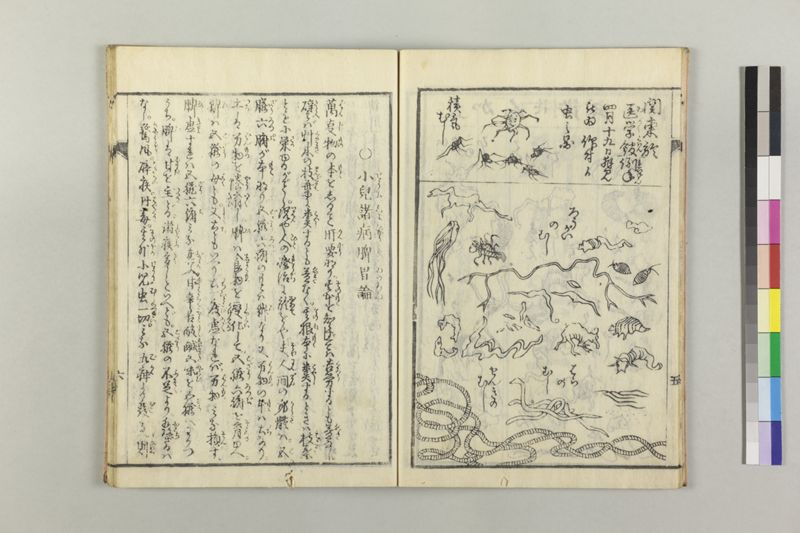
関東於
医学舘(ゐがくくはん)例年(れいねん)
四月十九日拝見
被為 仰付候
虫之図 ろう
がい はら
の の
むし むし
せんきの
むし
○ 小児諸病脾胃論(せうにしよびやうひゐのろん)
万事(ばんじ)物(もの)の本(もと)をしること肝要(かんやう)なり。其本(そのもと)を知らずしては苦労(くろう)するとも益(ゑき)なし。
譬(たとへ)ば草木(くさき)の枝葉(えだは)に糞(こやし)するとも益(ゑき)なく。其(その)根本(ねもと)に糞(こやし)するときは枝葉(えだは)
ともに栄(さか)ゆるがごとし。況(いはん)や人(ひと)の療治(れうぢ)に於(おゐて)をや。夫(それ)人間(にんげん)の身体(からだ)は。五(こ)
臓六腑(ざうろつぷ)が本(もと)なり。五臓六腑(ござうろつぷ)のもとは脾(ひ)なり。又/万物(ばんもつ)の本(もと)は土(つち)なり。
土(つち)は万物(ばんもつ)を《振り仮名:養育|やういく|やしなひ 》し。脾(ひ)は食物(しよくもつ)を《振り仮名:受化|じゆくは|うけこな 》して。五臓六腑(ござうろつぷ)を育(そだつる)ゆへ。
脾(ひ)は五臓(ござう)の母(はゝ)とも。又土(またつち)ともいへり。土一度虚(つちひとたびなく)なれば。万物(ばんもつ)みな損(そん)ず。
脾虚(ひきよ)すれは五/臓(ざう)六/腑(ふ)みな衰(おとろ)ふ。甘(あまく)辛(からく)苦(にがく)酸(すく)鹹(しほかたき)【ママ】五/味(あじはひ)を五/臓(ざう)へわかつ
うち。脾(ひ)は甘(あまき)を主(つかさ)どる。諸疾(しよしつ)多(おほ)しといへども。五臓(ござう)の不足(ふそく)より発(おこら)ざるは
なし。驚風(きやうふう)。碎疾(かたかい)。丹毒(はやくさ)。其外(そのほか)小児(せうに)。虫(むし)一切(いつさい)。みな五疳(ごかん)より発(おこ)る。則(すなはち)
現代語訳
関東の医学館において例年4月19日に拝見することを仰せつけられた虫の図
疳疾の虫、腹の虫
疳気の虫
○ 小児諸病脾胃論(小児のさまざまな病気における脾胃の理論)
万事、物の根本を知ることが肝要である。その根本を知らずしては苦労しても益がない。
たとえば草木の枝葉に肥料をやっても益がなく、その根本に肥料をやるときは枝葉
ともに栄えるようなものである。まして人の治療においてはなおさらである。そもそも人間の身体は五
臓六腑が根本である。五臓六腑の根本は脾である。また万物の根本は土である。
土は万物を養育し、脾は食物を受け入れ消化して五臓六腑を育てるゆえに、
脾は五臓の母とも、また土ともいわれている。土がひとたび虚すれば万物はみな損なわれる。
脾が虚すれば五臓六腑はみな衰える。甘・辛・苦・酸・鹹の五味を五臓へ分ける
うち、脾は甘味を主管する。諸々の疾患は多いといえども、五臓の不足から発生しないものは
ない。驚風・疳疾・丹毒・その外小児の虫、一切すべて五疳から発生する。すなわち
英語訳
Diagram of worms ordered to be examined annually on April 19th at the Medical School in Kanto
Kanshitsu-worm, abdominal worm
Kanki-worm
○ Theory of Spleen and Stomach in Various Pediatric Diseases
In all matters, it is essential to know the root of things. Without knowing the root, even hard work brings no benefit.
For example, fertilizing the branches and leaves of plants brings no benefit, but when fertilizing their roots, both branches and leaves
flourish together. How much more so in the treatment of people. The foundation of the human body consists of the five
organs and six bowels. The foundation of the five organs and six bowels is the spleen. Also, the foundation of all things is earth.
Earth nourishes all things, and the spleen receives and transforms food to nourish the five organs and six bowels, therefore
the spleen is called both the mother of the five organs and also earth. When earth becomes deficient once, all things are damaged.
When the spleen becomes deficient, the five organs and six bowels all decline. Among the distribution of the five flavors—sweet, pungent, bitter, sour, and salty—to the five organs,
the spleen governs sweetness. Although there are many diseases, none arise
without stemming from deficiency of the five organs. Convulsions, kanshitsu, erysipelas, and all other pediatric worm conditions arise from the five kan. That is to say,