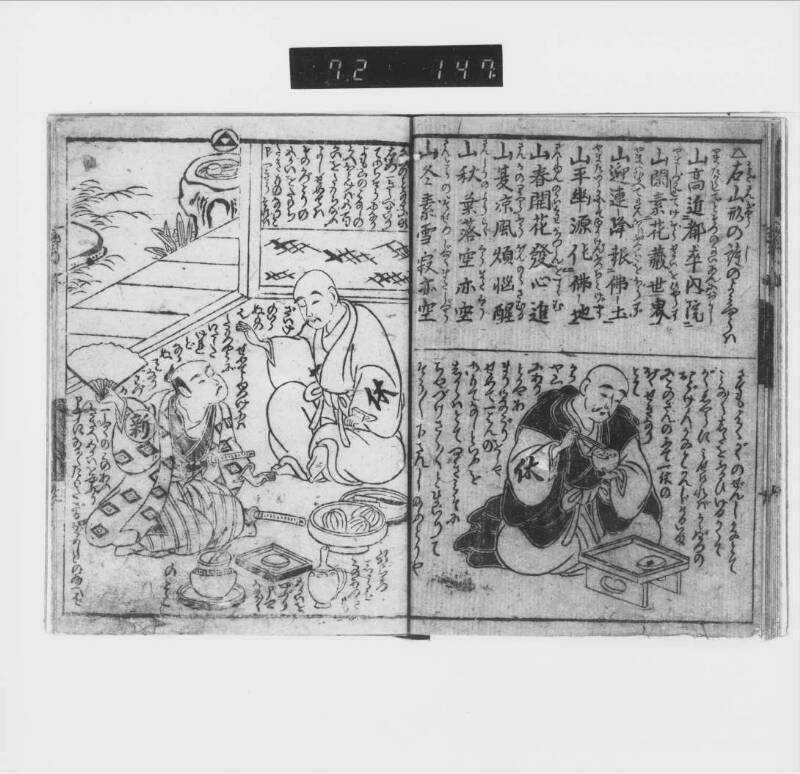
翻刻
【上段】
△右(みぎ)山形(さんぎやう)の詩(し)のよみやうは
《振り仮名:山高近_二都卒内院_一|やまたかうしてとそつのないゐんにおかし》
《振り仮名:山閑素_二華蔵世界_一|やましづかにしてけぞうせかいをひやうす》
《振り仮名:山迎連-峰報_二仏土_一|やまはむかへてれんほうぶつどをほうず》
《振り仮名:山平幽-源化_二仏地_一|やまたいらかにしてゆうげんふつちとげす》
《振り仮名:山春開花発心進|さんしゆんのかいくわほつしんをすすむ》
《振り仮名:山夏涼風煩悩醒|さんかのりやうふうぼんのうさむる》
《振り仮名:山秋葉落空亦空|さんしうのようらくうまたくう》
《振り仮名:山冬素雪寂亦空|さんとうのそせつじやくまたじやく》
【下段、弘法大師御影の賛を書いた話の続き】
さてもはくがくのぜんしかなとて
みな〳〵したをふるひけるかくて
がくしやらにみせければかくべつの
おどけ人かなとかんじけるいま
にこのさんのふて一休の
ぼくせきなり
とて
かう
や山
にあり
とかやあ
まり御なごりをしや
せめて一はんの
御もてなしといふを
しからはとてやきみそに
ちやづけさら〳〵とまいりて
そう〳〵下さんし給ふとかや
【ここより下巻】
□□のことなるに新
右衛門一きうへまいり
て御ちそうになり
よも山のはなしの
うへほとけは五百
かいをたもち給ふ
よしせめては
そのかづとりの
五かいをたもち
たきものなりと
申一きうそれは
ざいけ
のいら
ぬもの
也せめてしゆつけには
たもつやうに
いたした
けれ
ど
なら
ぬ
こと
なり
わづ
か
一しやくのこのあふ
ぎさへ五かいをやぶり
申すになか〳〵たもたざるがよしとのたまへば
新右衛門
しからば
このあふぎ
も
五かいを
やぶり
申や
なか〳〵
のこと
現代語訳
【上段】
△右の山形の詩の読み方は
《山高うして都率の内院に近し》
《山閑かにして華蔵世界を表す》
《山は迎えて連峰仏土を報ず》
《山平らかにして幽源仏地と化す》
《山春の開花発心を進む》
《山夏の涼風煩悩醒む》
《山秋の葉落空また空》
《山冬の素雪寂また寂》
【下段、弘法大師御影の讃を書いた話の続き】
「それにしても博学の禅師だなあ」とて、みな舌を振るった。このようにして学者らに見せたところ、「格別の洒落者だなあ」と感じた。今にこの讃の筆跡は一休の墨跡なりとて高野山にあるとか。あまりに名残惜しく、「せめて一飯のおもてなし」というを、「それならば」とて焼き味噌に茶漬けをさらさらと召し上がって、颯々と下山し給うとか。
【ここより下巻】
別のことであるが、新右衛門が一休へ参りて御馳走になり、よもやまの話の上で、「仏は五百戒をお守り給う。せめてはその数取りの五戒をお守りになりたいものです」と申した。一休は「それは在家には要らぬもの也。せめて出家には守るようにいたしたけれども、叶わぬことなり。わずか一尺のこの扇さえ五戒を破り申すに、なかなか守らざるがよし」とおっしゃれば、
新右衛門「それならばこの扇も五戒を破り申すや、なかなかのこと」
英語訳
【Upper Section】
△The way to read the mountain-shaped poem above is:
《The mountain is high and near to the inner court of Tusita Heaven》
《The mountain is quiet and represents the Flower Treasury World》
《The mountain welcomes and the connected peaks proclaim the Buddha Land》
《The mountain is level and transforms into the secluded source of Buddha Ground》
《Mountain spring's blossoming advances the awakening mind》
《Mountain summer's cool breeze awakens from worldly passions》
《Mountain autumn's falling leaves—emptiness and more emptiness》
《Mountain winter's pure snow—silence and more silence》
【Lower Section, continuation of the story about writing the eulogy for Kobo Daishi's portrait】
"What a learned Zen master indeed!" they all said, wagging their tongues in amazement. When they showed this to scholars, they felt "What an exceptionally witty person!" Even now, this eulogy's calligraphy is said to be Ikkyu's brushwork and remains at Mount Koya. Finding it too hard to part with him, they said "At least allow us to offer you one meal of hospitality." "Very well then," he said, and briskly ate some grilled miso with tea over rice, then swiftly descended the mountain.
【From here begins the second volume】
On another occasion, Shinemon visited Ikkyu and was treated as a guest. In the course of various conversations, he said, "The Buddha observes five hundred precepts. At the very least, one should observe those basic five precepts." Ikkyu replied, "Those are unnecessary for laypeople. I tried to have even monks observe them, but it's impossible. Even this fan, barely one foot long, causes me to break the five precepts—it's better not to try to keep them at all."
Shinemon said, "Well then, does even this fan cause you to break the five precepts? How remarkable!"