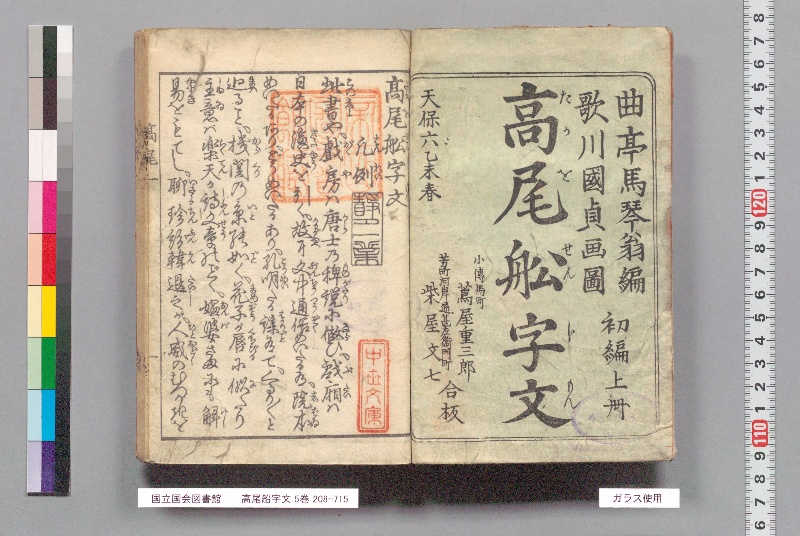
翻刻
曲亭馬琴翁編
歌川国貞画図 初編上冊
《題:高尾船字文(たかをせんじもん)》
小伝馬町
蔦屋重三郎
芳町河岸通甚左衛門町
柴屋文七
合板
天保六乙未春
高尾船(たかをせん)字 文(もん)
凡例(はんれい)
此書(このしよ)や。戯房(がくや)は唐土(から)の稗説(ものがたり)に倣(なら)ひ。戯扇(ぶたい)は
日本の演史(きたゆう)を引く、故(かるがゆへ)に文中(ぶんちう)通俗(つうぞく)めいたる有。院本(しばゐ)
めいたるあり。どうめいたるあり、孔明(こうめい)たる謀有(はかりごと)て、くるり〳〵と
廻(まは)ること。機関(からくり)の糸(いと)の如(ごと)く。花子(まめぞう)が唇(くちびる)に似(に)たり
主意(しゆゐ)は楽天(らくてん)か詩文章(しふんせう)のごとく。媼婆(おんば)さまにも解(けし)
易(やすき)をもてし。聊(いさゝか)珍紛(ちんふん)韓退之(かんたいし)が、人威(ひとおどし)のむつかきを
現代語訳
曲亭馬琴翁 編
歌川国貞 画図 初編上冊
《題:高尾船字文(たかをせんじもん)》
小伝馬町
蔦屋重三郎
芳町河岸通甚左衛門町
柴屋文七
合板
天保六乙未春
---
高尾船字文(たかをせんじもん)
凡例
この書は、趣向(舞台裏)は中国の読み物(稗説)に倣い、演出(舞台)は日本の浄瑠璃を引き合いに出している。それゆえ、文中には通俗的な表現もあれば、芝居めいた表現もあり、またそれ以外の様式もある。孔明のような謀略によって、くるくると話が展開すること、からくり人形の糸のようであり、また豆蔵(道化師)の唇のようでもある。この作の主旨は、白楽天の詩文のように、年老いた婆様にも分かりやすいことを目指している。わずかばかり、難解な韓退之のような人を煙に巻く難しい表現を……
英語訳
Compiled by Kyokutei Bakin
Illustrated by Utagawa Kunisada First Series, Upper Volume
《Title: Takao Senjibun (Tale of Takao's Ship Letters)》
Kodenma-chō
Tsutaya Jūzaburō
Yoshichō Kaganotōri Jinzaemon-chō
Shibaya Bunshichi
Joint publication
Spring of Tenpō 6, Year of the Wood Sheep (1835)
---
Takao Senjibun
Preface
This book follows Chinese popular fiction (biē shuō) in its backstage workings, while drawing upon Japanese jōruri performance traditions for its theatrical presentation. For this reason, within the text there are passages that have a popular, colloquial flavor; passages that have the feel of kabuki or puppet theater; and passages of yet other styles. The plot turns and revolves through stratagems worthy of Zhuge Liang (Kōmei), like the threads of a mechanical puppet, or like the lips of a Mamezō (comic street performer). The primary intent is that, like the poetry of Bai Juyi (Rakuten), it should be easy to understand even for an elderly grandmother. Though there is a slight sprinkling of the difficult, obfuscating style of Han Yu (Kantaishi), designed to intimidate readers...