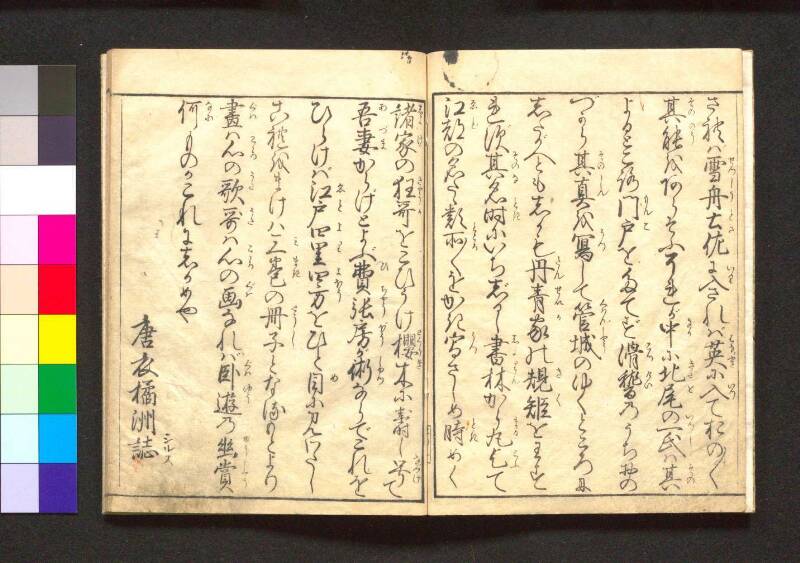
翻刻
されば雪舟(せつしう)土佐(とさ)に入(いり)されば英(はなぶさ)に入(いり)ておの〳〵
其(その)能(のう)をあらそふそれが中(なk)に北尾(きたを)の一氏(いつし)は其(その)
よるところ門戸(もんこ)をたてず滑稽(こつけい)のうちおの
づから其真(そのしん)を写(うつ)して管城(くはんしやう)のゆくところに
したがへともしかも丹青家(たんせいか)の規矩(きく)をわす
れず其名(そのな)時(とき)にいちじるし書林(しよりん)から丸(まる)乞(こふ)て
江都(ゑど)の名たゝる所(ところ)〳〵をかき写(うつ)さしめ時(とき)めく
諸家(しよけ)の狂哥(きやうか)をこひうけ桜木(さくらぎ)に寿し号(なづけ)て
吾妻(あづま)からげとよぶ費張房(ひちやうぼう)が術(しゆつ)ならでこれを
ひらけば江戸(ゑと)四里四方(よりよほう)をひと目(め)に見わたし
これをまけは三巻(みまき)の冊子(さうし)となるもとより
画(ぐは)は心(こゝろ)の歌(うた)哥(うた)は心(こゝろ)の画(ぐは)なれば臥遊の幽賞
何(なに)ものかこれにしかめや
唐衣橘洲 誌(シルス)
現代語訳
雪舟(せっしゅう)に入り、土佐派に入り、英一蝶(はなぶさいっちょう)に入って、それぞれその技量を競い合っている。その中で北尾の一氏は、特定の流派に属することなく門戸を立てず、滑稽な作風の中に自然とその真実を写し取って、筆の向かうところに従っている。しかも丹青家(画家)の規則を忘れることなく、その名は当時著名であった。
書林(出版業者)の丸屋から依頼を受けて、江戸の名高い場所々々を描き写させ、時代の寵児である諸家の狂歌を依頼して受け、桜木に因んで「吾妻からげ」と名づけた。費長房の術でなければ、これを開けば江戸四里四方を一目で見渡すことができ、これを巻けば三巻の冊子となる。
もとより絵は心の歌であり、歌は心の絵であるから、寝ながらにして遊び、静かに鑑賞する楽しみとして、何ものもこれに及ぶものがあろうか。
唐衣橘洲 記す
英語訳
Whether joining the Sesshū school, the Tosa school, or the Hanabusa school, each competes in their respective skills. Among them, the Kitao family does not establish allegiance to any particular school or gate, but within their humorous style, they naturally capture the truth, following wherever their brush leads. Yet they do not forget the rules of painters, and their name was renowned at the time.
Commissioned by the publisher Maruya, they had the famous places of Edo drawn and copied, solicited kyōka (comic poems) from the favored poets of various houses, and named the work "Azuma Karage" after the cherry tree. Without the arts of Fei Changfang, when opened, this allows one to survey all of Edo's four ri in every direction at a glance, and when rolled up, it becomes a three-volume booklet.
Since paintings are originally songs of the heart, and songs are paintings of the heart, what could surpass this for the pleasure of armchair travel and quiet contemplation?
Written by Karakoromo Kitsushū