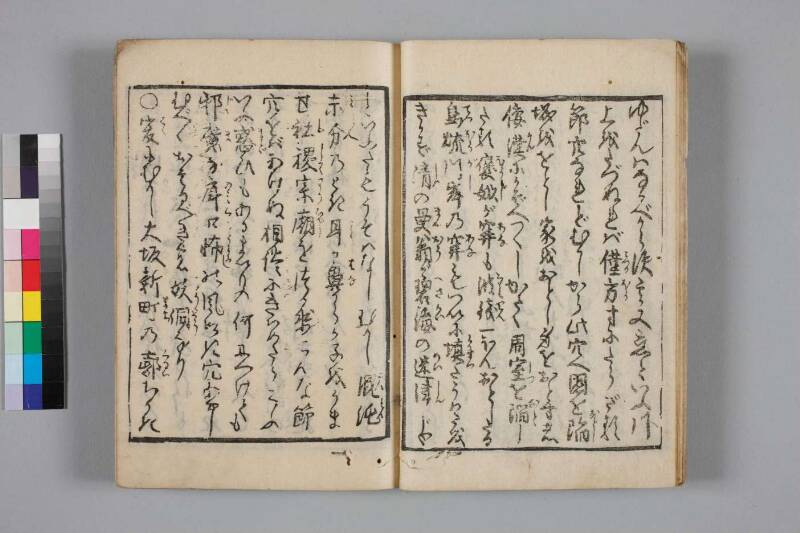
翻刻
ゆだんはなるべからす其又恋といふ川
上をたづぬれば僅(わつか)方(ほう)寸#3にたらざる節穴なれどむかしから此穴へ国を陥(おとし)
城ををとし家をおとし身をおとす者
倭 漢(かん)にかぞへつくしかたく周 室(しつ)を陥(おと)し
たる褒姒(ほうじ)#1が穽(あな)も波銭(なみせん)一ほんおとしたる
島□河岸#2の穽(あな)もついに填(うまつ)たうはさを
きかず清(しん)の曼翁(まんおう)が碧海(へさかい)の迷津(めいしん)じや
といふたもうそはなし#4むかし混沌(こんとん)
未分(みふん)のとき耳(みゝ)か鼻(はな)からか子をうま
せ社稷宗廟(しよくさうひやう)#5をつかせ□んな節
穴をばあけぬ相談にきはめたらこふ
いふ惑(まど)ひもあるまいもの何につけても
邪魔(じやま)な戽口(のみくち)#6怖(□そろし)の風ふき穴あやし
むべくおそるべきの妖洞(ようとう)なり
○爰(こゝ)にむかし大坂新 町(まち)の郭(くるは)ちかき
現代語訳
油断はなるべからず。その恋という川の上流をたずねれば、わずか方寸にも満たない節穴(ふしあな)に過ぎないけれど、昔からこの穴へ、国を陥れ、城を落とし、家を落とし、身を落とす者は、日本・中国を数え尽くしがたい。周室を陥れた褒姒(ほうじ)の穽(おとしあな)も、波銭一本を落とした島□河岸の穽も、ついに埋まったという話を聞かない。清の曼翁が「碧海の迷津じゃ」と言ったのも、まんざら嘘ではない。昔、混沌未分のとき、耳からか鼻からか子を産ませ、社稷・宗廟を継がせ、皆がみなあの節穴を開けぬ相談に決めておいたならば、こういう迷いもあるまいに。何につけても邪魔な飲み口よ。恐ろしの風吹き穴、怪しむべく恐るべき妖洞(ようどう)である。
○ここに昔、大坂新町の郭(くるわ)近くの(以下続く)
英語訳
One must never be off one's guard. If one traces the headwaters of this river called "love," it amounts to no more than a knothole barely an inch square — yet since ancient times, those who have through this hole brought ruin to countries, toppled castles, destroyed households, and laid waste to themselves are beyond counting in both Japan and China. The pit of Bāo Sì, who brought down the house of Zhou, and the pit of the Shima-□ riverbank into which a single wave-coin was dropped — neither, it is said, has ever been filled. The words of the Qing scholar Man'ō, who called it "the treacherous ford of the emerald sea," are by no means untrue. Had it been decided back in the age of primordial chaos, before heaven and earth were separated — when children might just as well have been born through the ear or the nose — that the dynastic shrines and altars of state be perpetuated, and that everyone unanimously agree never to open that knothole, then such delusions as these would never have arisen. In every matter, what a troublesome drinking-spout it is! A terrible wind-blowing hole — a suspicious and dreadful mystic cavern indeed.
○ Here, in the old days, near the licensed quarter of Shinmachi in Osaka — (continues)