翻刻
抄
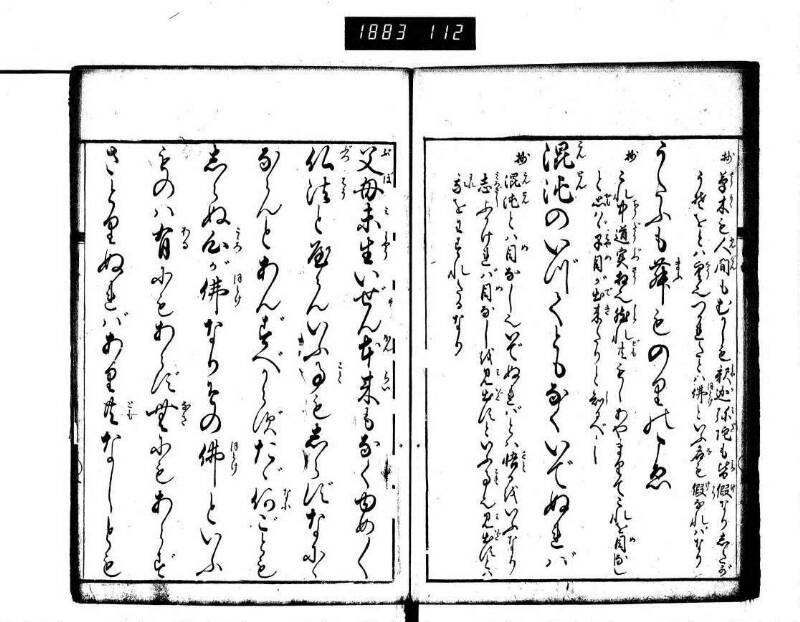
草木(さうもく)も人間(にんげん)もむかしも釈迦(しやか)弥陀(みだ)も皆(みな)仮(け)なりしたが
うそをとは空(くう)也つかれたとは仏(ほとけ)といふ名(な)も仮(け)なればなり
うたふも舞(まふ)ものりのこゑ
抄
これ中道(ちうだう)実相(じつさう)也 然(しか)れ共(ども)もしあやまりてこれを目(め)なし
と思(おも)はゞ早(はや)目(め)が出来(でき)たりと知(し)るべし
混沌(こんとん)のいづくともなくいでぬれば
抄
混沌(こんとん)とは目(め)なし也いでぬればとは悟(さと)るをいふなり
志(こゝろざし)ふかければ目(め)なしを見(み)出(いだ)すといふ事(こと)也 見(み)出(いだ)すとは
我(われ)をわすれたるなり
父母(ふぼ)未生(みしやう)いぜん本来(ほんらい)もなくゆめ〳〵
仏法(ぶつはう)とやらんいふ事(こと)もしらずなにゝ
ならんとあんずべからずたゞ何ごとも
しらぬ心(こゝろ)が仏(ほとけ)なりその仏(ほとけ)といふ
ものは有(ある)にもあらず無(なき)にもあらず
さとりぬればあり共(とも)なしとも
現代語訳
抄
草木も人間も昔も釈迦も弥陀も皆仮のものである。したがって
「嘘を」というのは空である。「つかれた」というのは、仏という名前も仮のものだからである。
歌うも舞うも法の声
抄
これは中道実相である。しかしながら、もし誤ってこれを目なし
と思えば、もはや目ができたと知るべきである。
混沌のどことも知れぬところから出てくれば
抄
混沌とは目なしのことである。「出てくれば」とは悟ることを言うのである。
志が深ければ目なしを見出すということである。見出すとは
我を忘れることである。
父母未生以前、本来もなく、夢にも
仏法とやらんいう事も知らず、何に
なろうと考えてはならない。ただ何事も
知らない心が仏である。その仏という
ものは有るのでもなく無いのでもない。
悟ってしまえば有るとも無いとも言えない。
英語訳
Extract
Plants, trees, human beings, the past, Shakyamuni, and Amida Buddha are all provisional. Therefore,
"lies" refers to emptiness. "Were told" means that even the name "Buddha" is provisional.
Singing, dancing, and the voice of the Dharma
Extract
This is the Middle Way, true reality. However, if one mistakenly thinks of this as "without eyes,"
one should know that eyes have already formed.
Emerging from somewhere unknown in chaos
Extract
Chaos means "without eyes." "Emerging" refers to awakening.
When one's aspiration is deep, one discovers "without eyes." To discover means
to forget the self.
Before father and mother were born, originally there was nothing, not even in dreams
did one know of something called the Buddha-dharma. One should not
think about what to become. Simply the mind that
knows nothing is Buddha. That thing called Buddha
neither exists nor does not exist.
Once awakened, it can be said neither to exist nor not to exist.