翻刻
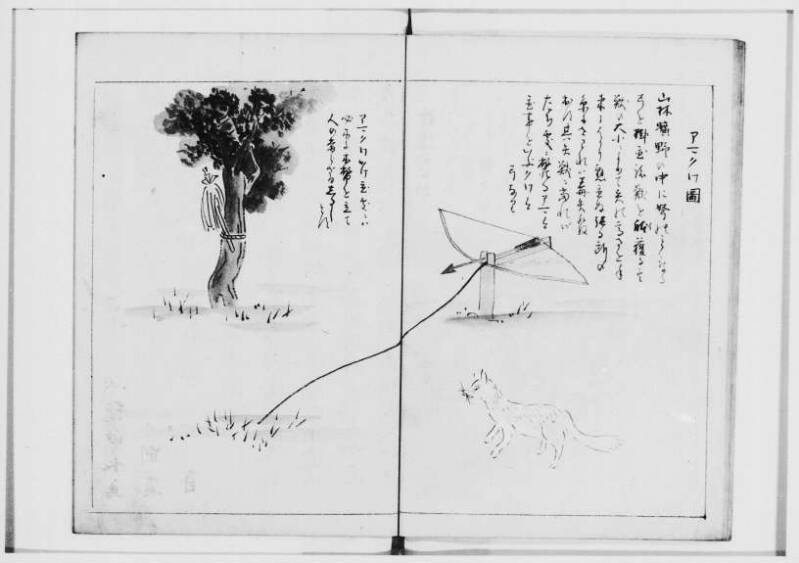
アマクワ図
山林曠野の中に弩のことくなる
弓を掛置諸獣を躰(イ)#1獲る其
獣の大小によりて矢の高さを手
束にはかり懸置ぬ張る所の
糸にさわれは毒矢発
出す其矢獣に当れば
たち処に斃るアマは
置事をいふクワは
弓なり
アマクワかけ置処には
必木に木幣を立て
人の当らざるしるし
とす
現代語訳
**アマクワの図**
山林や広野の中に、弩(おおゆみ)のような弓を仕掛けておき、さまざまな獣を捕らえる。その獣の大小に応じて、矢の高さを手の幅(手束)で測って仕掛ける。張ってある糸に触れると毒矢が発射される。その矢が獣に当たると、その場で即死する。「アマ」とは仕掛けること(置くこと)を言い、「クワ」とは弓のことである。
アマクワを仕掛けた場所には、必ず木にイナウ(木幣)を立て、人が誤って当たらないようにする目印とする。
英語訳
**Illustration of the Amakuwa**
In forests and open fields, a bow resembling a crossbow is set as a trap to catch various animals. Depending on the size of the animal to be caught, the height of the arrow is measured and adjusted using the width of a hand (tazuka). When an animal touches the stretched string, a poison arrow is fired. When the arrow strikes an animal, it dies instantly on the spot. "Ama" means to set or place a trap, and "kuwa" means a bow.
At the place where an Amakuwa is set, an inaw (wooden whittled stick used as a ritual offering, here called kibei/木幣) is always erected on a tree as a marker to warn people not to approach accidentally.