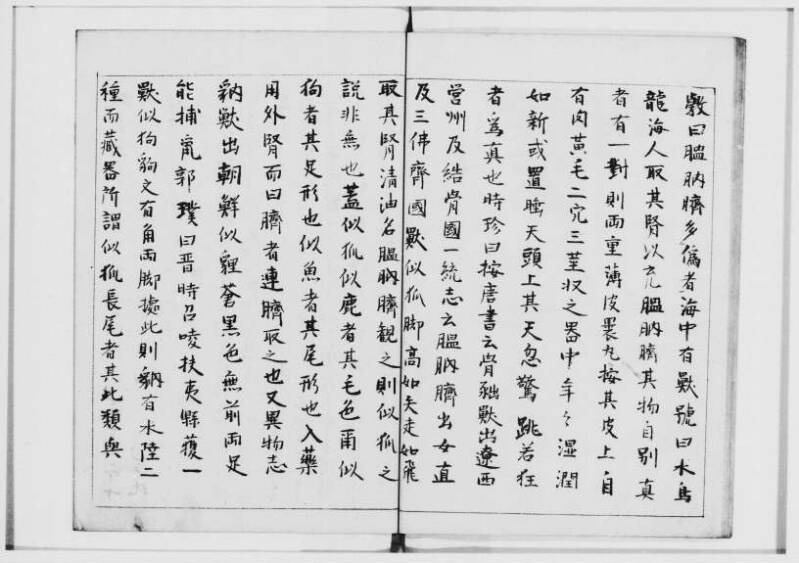
翻刻
斆曰膃肭臍多_二偽者_一海中有獣號曰水鳥
龍海人取其腎以充膃肭臍其物自別真
者有一対則両重薄皮裹丸按其皮上自
有肉黄毛二穴三茎収之器中年々湿潤
如新或置睡天頭上其天忽驚跳若狂
者為真也時珍曰按唐書云骨𧰹獣出遼西
営州及結骨国一統志云膃肭臍出女直
及三佛齊国獣似狐脚高如矢走如飛
取其腎清油名膃肭臍観之則似狐之
説非無也蓋似狐似鹿者其毛色爾似
狗者其足形也似魚者其尾形也入薬
用外腎而曰臍者連臍取之也又異物志
豽獣出朝鮮似貍蒼黒色無前両足
能捕鼠郭璞曰晋時召㖫扶夷県獲一
獣似狗豿文有角両脚拠此則豽有水陸二
種而蔵器所謂似狐長尾者其此類与
現代語訳
**【膃肭臍(おとせい)に関する考証】**
〔斆(きょう)が曰く〕膃肭臍には偽物が多い。海中に「水鳥竜」と呼ばれる獣がおり、海人(漁師)はその腎(睾丸)を取って膃肭臍として売りさばくが、その物は本物とは別物である。真物には一対(ひとそろい)があり、両面が薄い皮で包まれた丸い形をしており、その皮の上には自然と肉色の黄色い毛があり、二つの穴と三本の茎がある。これを器の中に収めると、年々しめりけを帯びて新しいもののようである。あるいは眠っている人の頭上に置くと、その人が突然驚いて飛び跳ね、狂ったようになるものが真物である。
〔時珍(李時珍)が曰く〕按ずるに、『唐書』に「骨𧰹獣は遼西・営州および結骨国に産出する」とある。『一統志』に「膃肭臍は女直(女真)および三仏斉国に産出し、獣は狐に似て、脚の高さは矢のようで、走ること飛ぶがごとし。その腎を清油に漬けたものを膃肭臍という」とある。これを見ると、狐に似ているという説も根拠がないわけではない。思うに、狐に似ている・鹿に似ているとは、その毛の色のことであり、犬に似ているとはその足の形のことであり、魚に似ているとはその尾の形のことである。薬に用いるのは外腎(睾丸)であるが、「臍(へそ)」と呼ぶのは、臍(へそ)ごと取るためである。
また『異物志』に「豽(だつ)という獣は朝鮮に産出し、貍(たぬき)に似て蒼黒色で、前足の両脚がなく、よくネズミを捕らえる」とある。郭璞(かくはく)が曰く、「晋の時代に召扶夷県において一頭の獣を捕獲した。犬に似て豿(ひょう)の文様があり、角を持ち、両脚があった」と。これによれば、豽には水陸の二種があり、蔵器(陳蔵器)のいわゆる「狐に似て長い尾を持つ」というのもこの類ではなかろうか。
英語訳
**[Scholarly Discussion on Ottosei (Fur Seal / Ossified Navel, 膃肭臍)]**
[Xiao (斆) states:] There are many counterfeits of *ottosei* (膃肭臍). In the sea there is a creature called the "Water-Bird Dragon" (水鳥竜), and fishermen (sea-people) take its kidneys (testes) and sell them as *ottosei*, but this substance is entirely different from the genuine article. The genuine specimen comes as a pair: two rounded pieces wrapped in thin skin, upon which there is naturally yellow, flesh-colored hair, with two orifices and three stems. When stored in a vessel, it remains moist year after year as if freshly obtained. Alternatively, if it is placed upon the head of a sleeping person and that person suddenly startles and leaps up as if in a frenzy, then it is genuine.
[Shizhen (Li Shizhen, 李時珍) states:] Upon investigation, the *Tang Shu* (唐書, History of the Tang Dynasty) records that "the *kottsu* beast (骨𧰹獣) is found in Liaoxi, Yingzhou, and the land of Jiegu." The *Yitong Zhi* (一統志, Comprehensive Gazetteer) records: "Ottosei (膃肭臍) is produced in Jurchen (女直) and the land of Srivijaya (三仏斉国). The animal resembles a fox, its legs are as high as an arrow, and it runs as if flying. Its kidneys are soaked in clear oil and called *ottosei*." From this, the claim that it resembles a fox is not without basis. In general, the comparisons to a fox or deer refer to the color of its fur; the comparison to a dog refers to the shape of its feet; and the comparison to a fish refers to the shape of its tail. Though the part used in medicine is the external kidney (testes), it is called "navel" (*sei*/臍) because the navel is taken along with it.
Furthermore, the *Yiwu Zhi* (異物志, Record of Strange Things) states: "The *da* (豽) beast is found in Korea (朝鮮), resembles a badger (*tanuki*/貍), is dark bluish-black in color, lacks both front legs, and is adept at catching mice." Guo Pu (郭璞) states: "During the Jin dynasty, in Zhaofu Yi County, one beast was captured that resembled a dog with the markings of a leopard (*bào*/豿), had horns, and had two legs." Based on this, there appear to be two varieties of *da* — aquatic and terrestrial — and what Zang Qi (蔵器, Chen Zangqi) described as "resembling a fox with a long tail" may well belong to this category.