翻刻
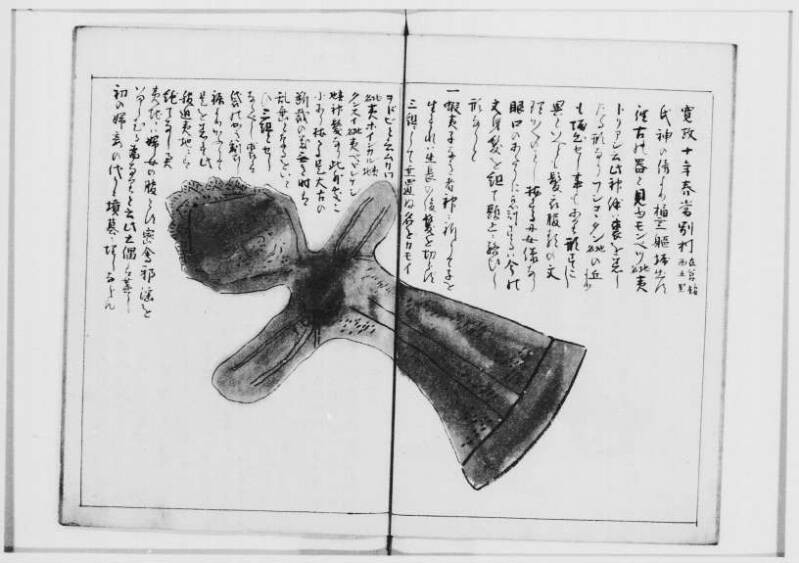
寛政十年春当別村《割書:在筥館|西五里》
氏神の傍より桶#1二十二躯堀出す
往古の器と見ゆモンベツ《割書:地|名》夷
トリアシ云此神体は裘を着し
たる形なりフシコヽタン《割書:地|名》の丘より
も堀出せし事もあり形すこし
異といへとも髪衣服類の文
理かくのことし按するに女像なり
眼口のあたりに点刺するは今の
文身髪を組て頭上に結ひし
形なりと
一蝦夷子なき者神に祈りて子を
生すれは生長の後髪を切らず
三組にして垂置ぬ名をカモイ
オドビと云ムカワ
《割書:地|名》夷ホインカル《割書:夷|地》
クンスイ《割書:地|名》夷ペヾレケシ
《割書:夷|地》神髪なり此外処々
にあり按るに是大古の
断裁の器無き時は
乱垂となるをいと
ひ三組とせし
なるべし裘は
袋の如く製し
裾よりかふりて
此を着す此
服近夷地には
絶てなし奥
夷地には婦女の服とす密会邪淫を
いましむる為なりと云此土偶は蓋し
初の婦妾の代りに墳墓に埋しならん
現代語訳
**[当別村の土偶発掘と蝦夷の風習について]**
寛政十年(1798年)春、当別村(箱館より西へ五里の地)の氏神の傍らから、桶状のもの二十二体が掘り出された。これらは往古の器と見られる。モンベツ(地名)の夷人がトリアシと呼ぶこの神体は、裘(毛皮の衣)を着した形をしている。フシコヲタン(地名)の丘からも掘り出されたことがあり、形はやや異なるとはいえ、髪や衣服の文様・理りはこれと同様である。考察するに、これは女性像である。眼や口のあたりに点刺(入れ墨)があるのは、現在の文身(いれずみ)と同じであり、髪を組んで頭上に結った形をしている。
一、蝦夷人で子のない者が神に祈って子を授かった場合、その子が成長した後も髪を切らず、三つ組にして垂らしたままにしておく。これを「カモイオドビ」と呼ぶ。ムカワ(地名)の夷人やホインカル(夷地名)・クンスイ(地名)の夷人・ペヾレケシ(夷地名)にこの神髪の者がいる。この他、各地にも見られる。考察するに、これは太古に髪を断ち切る道具がなかった時代には、髪が乱れて垂れ下がるのを嫌って三つ組にしたのであろう。
裘は袋のように仕立てられており、裾から被って着るものである。この服装は近い夷地には全く見られない。奥の夷地では婦女の服とされており、密会・邪淫を戒めるためと言われている。この土偶は、おそらく初めのころ、婦妾の代わりに墳墓に埋めたものであろう。
英語訳
**[On the Excavation of Clay Figurines at Tobetsu Village and Ainu Customs]**
In the spring of the tenth year of Kansei (1798), twenty-two barrel-shaped objects were excavated near the tutelary shrine at Tobetsu Village (located five ri to the west of Hakodate). These appear to be artifacts from ancient times. The Ainu of Mombetsu (a place name) call these sacred objects "Toriashi," and they take the form of a figure dressed in a fur garment. Objects have also been excavated from a hill at Fushikootan (a place name); though their shapes differ slightly, the patterns of the hair and clothing are the same as those described here. Upon examination, these appear to be female figures. The dots pricked around the eyes and mouth resemble the tattoos (mojiri) practiced today, and the hair is depicted braided and bound atop the head.
One account notes: Among the Ainu, when a childless person prays to the gods and is blessed with a child, after the child grows up, the hair is left uncut and braided into three plaits, left to hang freely. This is called "Kamoi Odobi" (sacred hair of the gods). Ainu bearing this sacred hair can be found at Mukawa (a place name), Hoinkaru (an Ainu place name), Kunsui (a place name), and Peberekes (an Ainu place name), and it can also be seen in various other locations. Upon reflection, this practice likely originated in ancient times when there were no tools for cutting hair — to avoid the dishevelment of loose, hanging hair, people braided it into three plaits.
The fur garment is fashioned like a bag and is worn by pulling it over the body from the hem upward. This style of dress is entirely absent in the Ainu lands closer to Wajin territory, but in the more distant Ainu lands it serves as women's clothing, said to be worn in order to discourage clandestine meetings and sexual misconduct. These clay figurines were most likely buried in graves as substitutes for concubines and wives in the earliest times.