翻刻
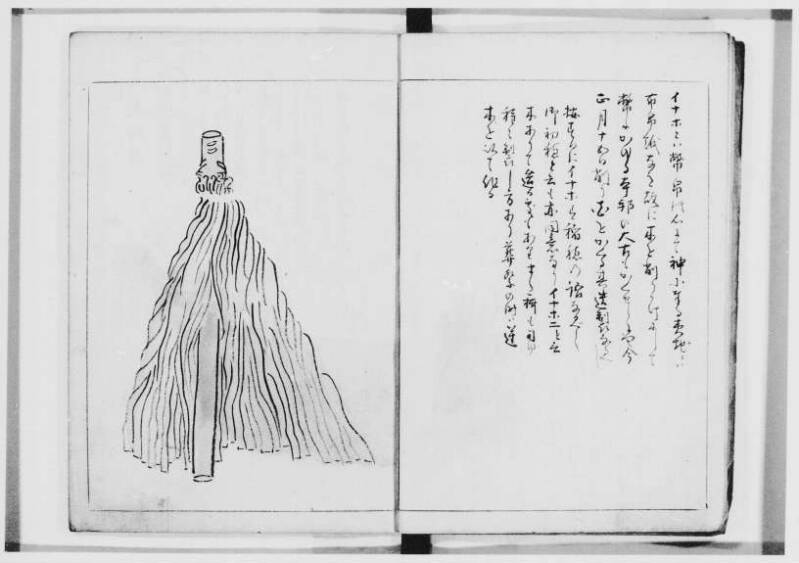
イナホとは幣帛の心にて神に奉る夷地には
布帛紙なき故に木を削りかけにして
幣にかゆる本邦の大古もかくせしにや今
正月十五日削り花をかくる其遺製なるへし
按するにイナホは稲穂の語なるべし
御初穂と云も亦同意なりイナホニと言
木ありて造る処もありまた柳も用ゆ
種々製し方あり葬祭の時は逆
木を以て作る
現代語訳
イナホとは幣帛(ぬさ)の中心となるものであり、神に奉るものである。蝦夷地には布や紙がないため、木を削って削り掛けにし、幣帛の代わりとしている。わが国の大昔もこのようにしていたのではないだろうか。今日、正月十五日に削り花を飾る習慣があるが、それはこの名残であろう。
考察するに、「イナホ」とは「稲穂」という言葉であろう。「御初穂」と言うのも同じ意味である。「イナホニ」と呼ばれる木があり、それで作る地域もあるし、また柳を用いる場合もある。様々な作り方があり、葬祭の時には逆さに立てた木(逆木)を用いて作る。
英語訳
"Inaho" refers to the central element of the nusa (ritual offerings), which is presented to the gods. Since there are no cloth or paper in Ezo (Hokkaido), wood is shaved into curling shavings (kezurikake) to serve as a substitute for ritual offerings. Perhaps this was also the practice in ancient Japan. Even today, the custom of decorating with "kezuri-hana" (shaved flower ornaments) on the fifteenth day of the New Year may be a remnant of this tradition.
Upon reflection, "Inaho" likely derives from the Japanese word for "rice ear" (稲穂, inaho). The term "o-hatsuhо̄" (first fruits offering) carries the same meaning. There is a tree called "Inahoni" which is used to make these in some areas, while willow is also used in others. There are various methods of production, and during funeral rites, they are made using wood placed in an inverted (upside-down) manner.