翻刻
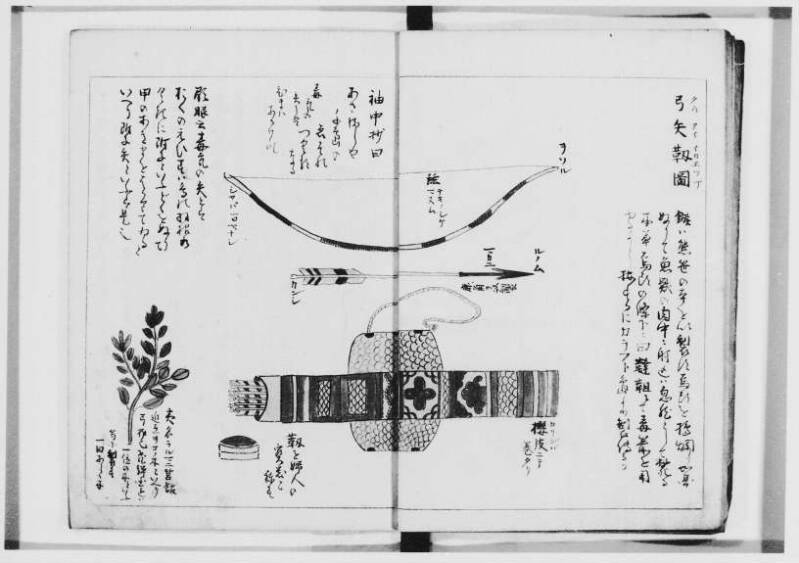
弓(クウ)矢(アイ)靭(イカヱツプ)図 鏃は熊笹の本を以製す烏頭#1を搗爛し如図
ぬりて魚獣の肉中に射込は忽然として斃る
本草烏頭の条下に曰韃靼にて毒箭を用
ゆるよし按するにカラフト島より製伝るか
ヲソル
絃《割書:テキノシケ|マスム》
シヤパ一曰ペナシ
ルノム
マカニ 鹿角ヲ以製
カンシ
桜皮(カリンバ)ニテ
巻タリ
靭を婦人の
宝器と
称す
袖中抄曰
あさましや
千島の
ゑその
つくる
なる
毒気の
矢こそ
ひまは
あるけれ
顕眼云毒気の矢とは
おくのえひすは鳥の羽根の
くきに附子といふどくをぬりて
甲のあきまをはかりてゐると
いへり附子矢といふは是也
夷名ラルマ二筥館
近在ヲコノ木といへり
弓材也飛騨国迄#2は
一位の木といふ
笏に製す
一曰あらゝ木
現代語訳
**弓・矢・靭(矢筒)の図**
鏃(やじり)は熊笹の根元を材料として作る。トリカブト(烏頭)を搗き砕いてどろどろにし、図のように塗って魚や獣の肉中に射込むと、たちまち斃(たお)れる。
『本草』の烏頭の条に言う、韃靼(タタール)では毒矢を用いると。考えるに、これはカラフト島(樺太)から製法が伝わったものであろうか。
- **ヲソル**(弓)
- 弦:テキノシケ・マスム
- **シヤパ**(一名ペナシ)(弓の部位)
- **ルノム**(矢)
- **マカニ** 鹿の角で製作する
- **カンシ**(鏃)
- 桜皮(カリンバ)にて巻いてある
靭(矢筒)は婦人の宝器と称される。
『袖中抄』に曰く、
「あさましや 千島のえその つくるなる 毒気の矢こそ ひまはあるけれ」
『顕眼』に言う、毒気の矢とは、奥の蝦夷(えびす)は鳥の羽根の茎にトリカブト(附子)という毒を塗り、甲の隙間を狙って射ると言われる。附子矢というのはこれである。
夷名(アイヌ名)でラルマ、二筥館(ふたはこだて)近在ではオコノキという。弓の材料となる木で、飛騨国ではイチイの木という。笏(しゃく)に製す。一名、アララキ。
英語訳
**Illustration of Bow (Ku), Arrow (Ai), and Quiver (Ikaetsupu)**
The arrowheads are made from the base of the kumazasa bamboo grass. Monkshood (aconite/Aconitum, *Uzu*) is pounded into a paste and applied as shown in the illustration. When shot into the flesh of fish or animals, they fall dead immediately.
The *Honzō* (Materia Medica) entry on monkshood states that the Tartars (Dattan) use poisoned arrows. On reflection, this technique may have been transmitted from Karafuto (Sakhalin) Island.
- **Osoru** (bow)
- Bowstring: *Tekinoshike* / *Masumu*
- **Shyapa** (also called *Penashi*) (part of the bow)
- **Runomu** (arrow)
- **Makani** — made from deer antler
- **Kanshi** (arrowhead)
- Wrapped with cherry bark (*Karinba*)
The quiver is referred to as a treasured possession of women.
*Sōchūshō* states:
"How dreadful — the poisoned arrows made by the Ezo of Chishima (the Kuril Islands), which have gaps [between them]."
*Kengen* states: "Poisoned arrows" refers to the practice of the Ezo of the far interior, who coat the quill of a bird's feather with the poison called *Bushi* (aconite/monkshood) and are said to aim for gaps in armor. What is called a *Bushi-ya* (aconite arrow) is precisely this.
The Ainu name [for the bow wood] is *Raruma*; in the vicinity of Futahakodate, it is called *Okono-ki*. It is the material used for making bows. In Hida Province, it is called the *Ichii* (Japanese yew). It is also fashioned into *shaku* (ceremonial baton). Another name is *Araraki*.